The Best Part of Algospeak Is the Part Everyone Called Filler

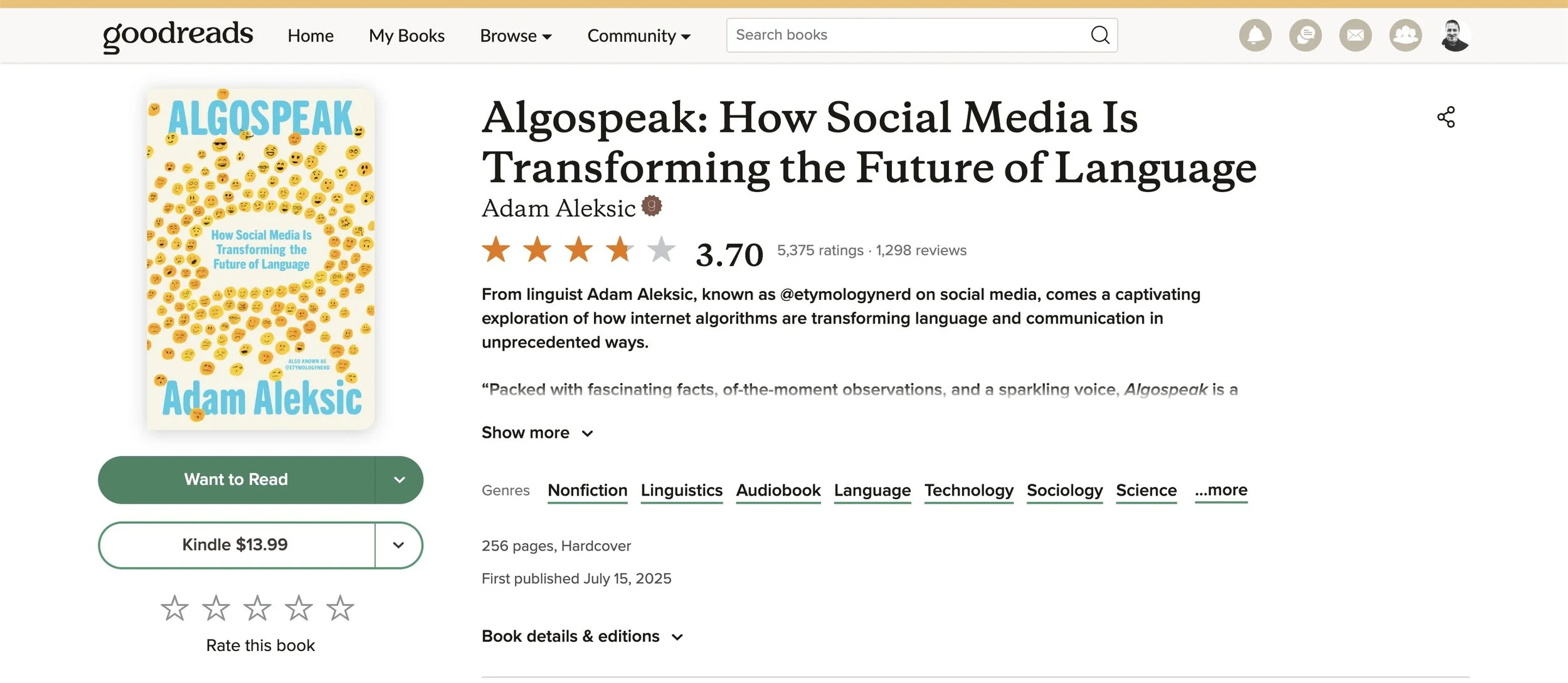
Adam Aleksic's Algospeak sits at 3.70 stars across 5,375 ratings and 1,298 written reviews on Goodreads. That is a strange number for a book from Knopf by a guy with three quarters of a million followers. It is not the number of a book people ignored. It is the number of a book people bought, finished, and got mad at.
I read the reviews before I read the book, which is backwards, and I recommend it. The complaint is remarkably consistent across the one-stars and the two-stars: readers came for linguistics and got a content creator talking about his own videos. They are right about that. They are also, to a person, wrong about which half of the book has anything in it.
I run social and shoot content for food, beverage, CPG and lifestyle brands. Chips and salsa, tortillas, boats, tires. The half of Algospeak that Goodreads treats as padding is the half I would photocopy and hand to a client before their next quarter of content. The half everybody wanted more of, the etymology, is the half I could get off Know Your Meme in four minutes. That inversion is the whole story of this book, and nobody reviewing it seems to have noticed.
What the reviewers actually said
The pattern shows up immediately. One reader with 232 likes on their review wrote that "Aleksic spends more time talking about which of his videos trended and why than analyzing language," and treated that as a fatal flaw. Another put it more bluntly: "his book is little more than a collection of anecdotes loosely strung together about being an influencer."
A two-star reviewer got closer to naming the thing without meaning to. "I didn't pick up this book to learn how to craft a compelling TikTok video or Instagram caption," they wrote, then asked, "do we really need ~100 pages about what exactly makes a good TikTok video?" A former sociolinguist, one of the more generous readers at three stars, said the book "often feels more like a self-aggrandizing how-to guide on becoming an effective influencer within that space."
The sharpest line came from a two-star review barely a hundred words long: "this feels as if it was written by a content creator first and an etymologist second."
Yes. That is correct. And that is the book's only real asset.
Why the "filler" is the load-bearing wall
Here is what I have watched happen in client accounts over the past three years, none of which any linguistics department has published a paper on.
A food brand cannot say certain words in a caption without the reach falling off a cliff. Not banned words. Ordinary ones. We have rewritten product copy because a spice level descriptor tanked a post's distribution two runs in a row, and there is no appeals process, no documentation, no support ticket that gets answered. You learn it by watching your own numbers, which is exactly the method every reviewer accused Aleksic of using and exactly the method that is available.
The influencer accent is real and it is now in brand video. I have sat in edit reviews where a client asked why the talent sounds like that, and the honest answer is that the cadence, the front-loaded first three seconds, the upward push at the end of a clause, all of it is a compression artifact of retention graphs. It was not a style choice. It was selected for. Aleksic has a chapter on this. It is genuinely useful and it is one of the chapters people called meandering.
Brands are speaking a moderation dialect and most of them do not know it. That is a marketing story, a compliance story and a language story at the same time. The book is the first mass-market thing I have read that documents it from inside the machine rather than from a lecture hall.
One three-star reviewer, who spent most of their review complaining that the how-to section was "drawn out," ended up conceding the point anyway: "I found it to be insightful coming from someone who makes a living from this world." That is the review buried inside all the bad ones.
The criticism that lands
I am not going to defend the whole book. The reviewers who went after the sourcing are correct and it is not a small problem.
A one-star reviewer counted the evidence and found it thin: the book "consists of almost entirely Aleksic's first-person accounts of the TikTok/Instagram/Reddit algorithms," they wrote, and then delivered the line that should have been in the editorial memo: "That's a sample size of 1."
That reviewer is right, and it matters more than it would in most books, because a sample size of one is precisely what every brand manager already has. My own account data is a sample size of one. The reason to buy a book about algorithms is to get out of the n=1 trap, and Algospeak mostly does not get you out of it. It just gives you a better documented, more articulate n=1 than your own.
Then there is the accuracy problem. A reader quoted a line straight out of the book that says of pre-internet men, "Before the internet, lonely men simply didn't have a way to gather and share ideas," which is the kind of sentence that makes you check every other claim on the page. Another reader caught the book explaining a Korean term incorrectly and noted, reasonably, that "this is a book about words like these, you would expect it to get basic info right." A third summarized the whole experience: "TL;DR: lazy, inconsistent writing and more about social media than language."
Even the people who liked it flag the wandering. A four-star review called it "an in depth analysis of not just recent slang, but the algorithmic pressures that spawned it," which is a fair description of what the book is trying to be, and a two-star review found the same material "shallow and repetitive."
My favorite criticism, because it is the truest one and the funniest, came from a reader who wrote that the author "wants the tiktok virality AND the moral upper hand of condemning the flattening of nuance that comes with achieving internet fame." That tension runs through every chapter. Aleksic is documenting a system that rewards a specific kind of flattening while being extremely good at producing that flattening, and he never quite decides whether he is a witness or an exhibit.
He is an exhibit. That is fine. Exhibits are useful.
The publishing math nobody wants to say out loud
One reviewer worked out the business model in a paragraph and I think they nailed it: the idea got picked up fast because the author had a built-in audience to sell to. Whether that is cynical or just how books work now, the result is a 256-page hardcover that several readers said should have been a long article. Multiple reviewers used almost the same words. A book stretched to book length because book length is the unit publishers sell.
Which brings me to what I actually think happened here. Algospeak was marketed as linguistics because linguistics is respectable and a manual for creators is not. The subtitle promises the future of language. The cover has a Harvard credential hovering behind it. And the reviews are full of people who feel bait-and-switched, including one who proposed the honest subtitle: "How algorithms influence influencers and influencers influence language."
That is the book. That is a good book. It sold under a cover that promised a different one, and it got a 3.70 for the mismatch rather than for the contents.
Who should actually buy it
If you want linguistics, skip it and read Gretchen McCulloch's Because Internet instead, which is what a two-star reviewer recommended in the middle of their own takedown and which is correct advice.
If you run a brand account, shoot content, or write captions for anybody who sells a physical product, buy the hardcover and read chapters four through eight. Skip the etymology. Do not expect citations. Treat it the way you would treat a long conversation with a working creator who has more platform data than you do and no incentive to lie about what stopped working. That is worth the cover price. It is not worth a linguistics degree and Aleksic never should have implied otherwise.
The reviewers on Goodreads wanted the book to be smarter. I wanted it to be more honest about being a trade manual. Between those two disappointments, mine is cheaper to fix. Somebody just needed to change the cover.
I help clean-label food brands build real organic communities through strategy, content, and brand storytelling. If your content feels busy but ineffective, that is the problem I fix. Follow me @gallucciNET on social media.

adage, emmy, telly & webby award-winning digital marketing consultant for purpose-driven food & beverage brands.