
CASE STUDIES / THE HUB BETWEEN YOUR AGENCIES
You don't have a marketing team. You have seven agencies.
Creative, PR, field, in-store, media, email, web. Each one is good at its job and none of them is paid to make the others' work fit. Somebody has to sit in the middle, speak all seven languages and keep it one brand. That's a job I've done for a brand with a full roster of agencies and for a founder with three specialists.
CASE STUDY 1
TOPO CHICO / THE DIGITAL PLAYBOOK / 2018 TO 2023
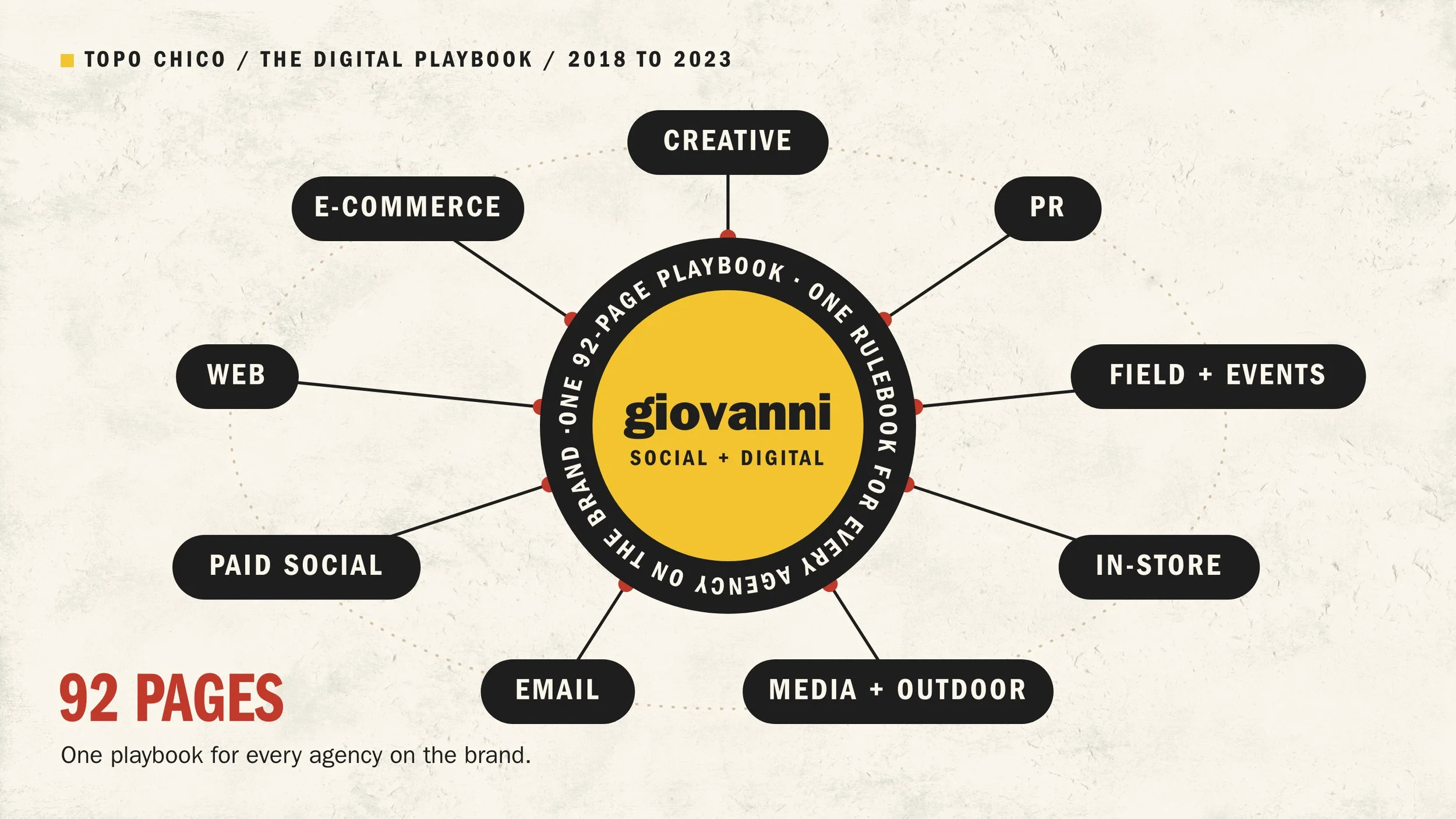
One rulebook for every agency on the brand.
The situation:
After Coca-Cola bought the brand, the team around it grew fast. By 2021 there was a creative agency, a PR agency, a field marketing and events agency, a shopper marketing agency for in-store, a media agency buying outdoor, a paid social team, the parent company's email marketing team, two web agencies and an e-commerce builder. Each could post, publish or print something with the brand's name on it. I had been the brand's online voice for eight years and was the one person who had been there the whole time.
What I did:
Wrote the brief for a digital playbook in December 2018, before the new agencies arrived, hired a design agency to produce it, and reviewed it with them every week.
Put the rules in writing: who the brand is for, what each channel is for, what we never post, what a good post looks like in numbers.
Handed it to every incoming agency in January 2021, and to the field team that summer. Kept it current through four editions. The May 2023 edition ran 92 pages.
Sat on the weekly all-agency council as the social and digital lead.
Gave all the agencies one template for recaps and playbooks, "to put us on a path where we are producing documentation that is similar across all agencies."
What that looked like on an ordinary week:
The paid social team couldn't track sales because the tracking code wasn't on the store. I installed my half and told the e-commerce builder exactly which three events to add. Two days later: "Confirming the domain is verified! Thank you for your help there."
The media agency was planning a city program. I asked to be on the thread "so I can pass along any necessary info" to field and creative.
The creative agency asked for more posts on the main feed. They got one a week, and everything else they asked for.
The email team was planning its next two sends and asked if the fall coffee campaign should be in them. I said yes, and the shopper agency supplied the artwork so the email matched the site and the feed.
An agency's video came in with the wrong yellow. It went back.
When the agencies presented separately, I pushed them to present together, "so each concept had a thread showing a storyline and workflow from one agency to another."
What the client said (marketing lead, Coca-Cola, 2022), sending a document around:
"Adding Gio as he would need this for Social/Digital integration."
What it means for you:
The more partners you add, the more your brand sounds like a committee. A written rulebook and one person who knows all the players is cheaper than fixing it afterward.
CASE STUDY 2
TOPO CHICO / THE YELLOW ROOM AND THE YELLOW ALBUM / 2021 TO 2022
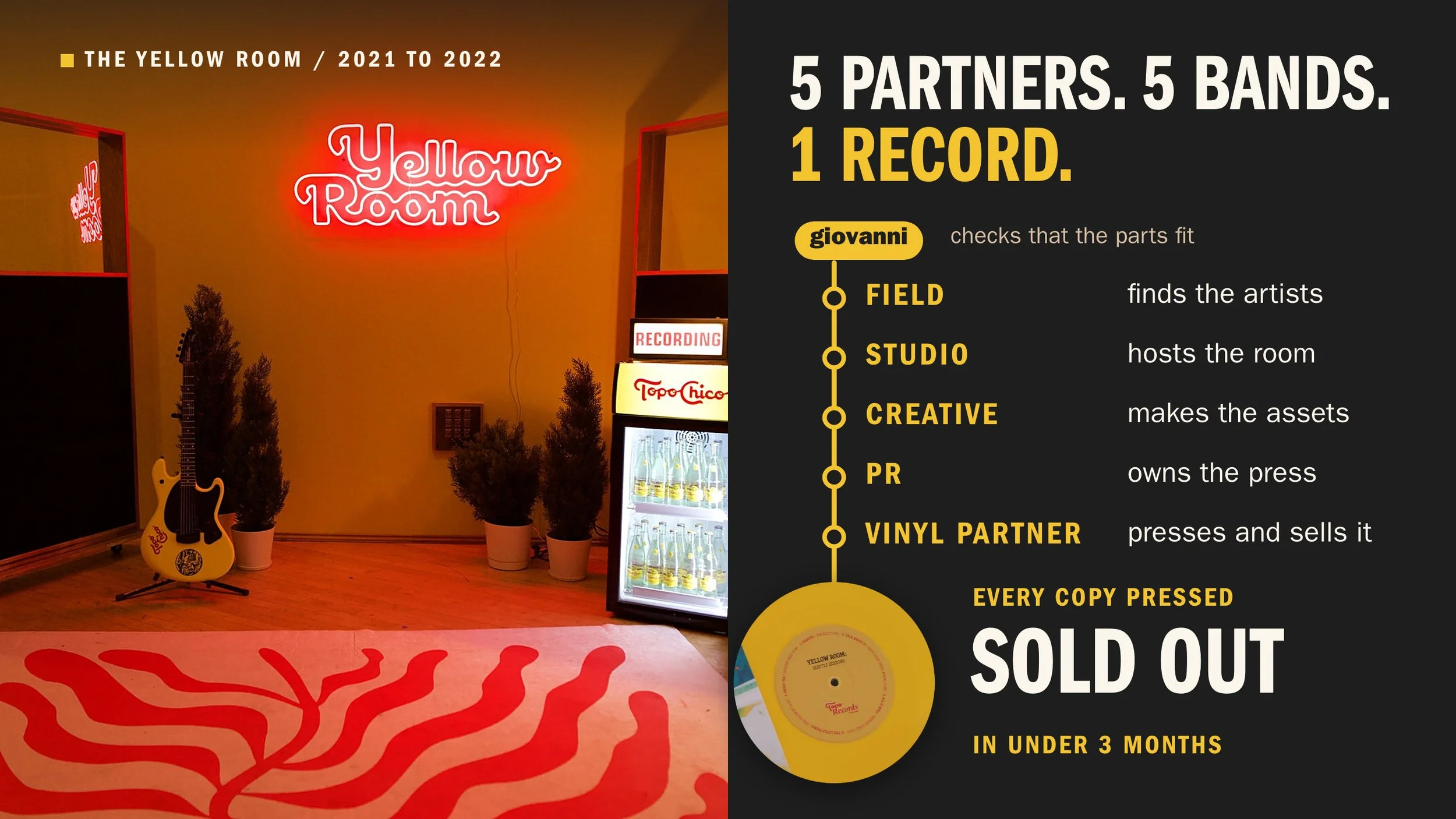
Five agencies, five bands, one record.
The idea:
After the Yellow Guitar, the brand wanted to give emerging musicians something real: studio time, exposure and money. The plan was a pop-up recording room in Seattle, five local artists, and a vinyl EP with every dollar going to the musicians.
Who did what:
daniel matson (a literal rock star) from our field marketing agency found the artists and ran the local event.
The PR agency owned press.
The creative agency made the assets.
A Seattle studio hosted the room, built in a week.
A vinyl subscription company pressed and sold the record.
I was the lead named between the field agency and the PR agency in the project playbook, I owned the brand's social, and the PR team asked for my sign-off on the shot list before it went to the client.
What happened (from the project recap):
194 placements across press and partner channels and 2.2 million impressions.
The record sold out. Every copy we pressed was gone in under three months, with all proceeds going to the musicians.
On the brand's own channels, which were mine: 72 video posts across four platforms, 355,000 plays and 16,900 likes, comments, shares and saves.
84 percent of the press stories carried the brand's own assets or links.
What I'd tell you straight:
The press numbers are the PR agency's. The record took longer to press than planned, and national editors wanted more than one city. Both are in the recap, and both are things I'd plan for next time.
What it means for you:
A project with five partners works when everyone knows exactly which part is theirs and one person is checking that the parts fit.
CASE STUDY 3
TIA LUPITA FOODS / HOT SAUCE AND CACTUS TORTILLAS / 2020 TO 2021
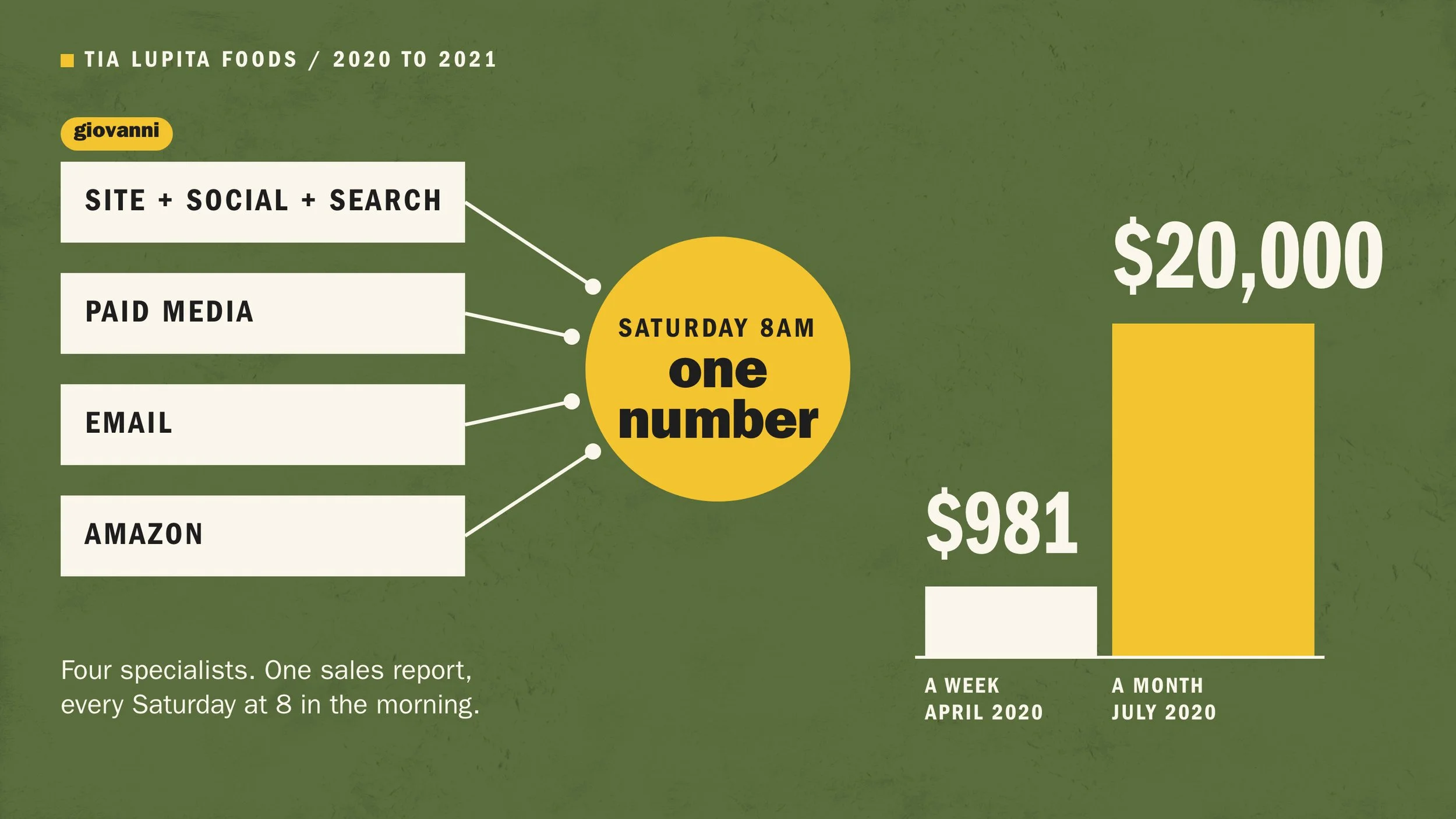
Four specialists, one number every Saturday.
The situation:
In spring 2020 a small hot sauce company had to move online in a hurry. The founder had a paid media specialist, an Amazon strategist, an email marketer and me on site, social and search. He said it plainly: he wanted us aligned so we weren't "overlapping or double working on same things." And the website was sitting on a former designer's personal hosting account. In April it went down and nobody at the company could log in.
What I did:
Moved the store to Shopify inside my retainer hours and pointed the domain at it the day the old site failed.
Told the team the rule going forward: the brand owns and has admin access to everything.
Set up one sales report that went out every Saturday at 8 in the morning, so paid, Amazon, email and social were all judged against the same number.
Made the assets the others needed. When Amazon rejected a video ad, I recut it to their spec. When the paid specialist needed an image for an ad, I sent it and the strategist wrote the copy.
Named what was missing, an overall brand strategy, and offered to own it.
What happened:
First Saturday report, April 2020: $981 for the week.
Three months later, the founder to the whole team: "3 months ago, our monthly combined online sales were around 400 dlls. Right now we are selling 20k a month! That is 50X growth."
January 2021: record months on both Amazon ($22,700) and the brand's own store ($17,300).
The founder again: "I am so grateful to have an all star marketing team that is helping us make this happen."
What I'd tell you straight:
That growth belongs to four people and a founder who pushed hard. My part was the store, the social, and making sure all of us were looking at the same number.
What it means for you:
You don't need a big agency. You need three or four good specialists and someone making sure they're working on the same plan.
I'm the hub. They're the spokes.
If you already have agencies and it still feels like nobody is steering, that's the job. Tell me who's on your team and I'll tell you where I'd fit.