CPG branding agency: ask if the brand survives post number 15
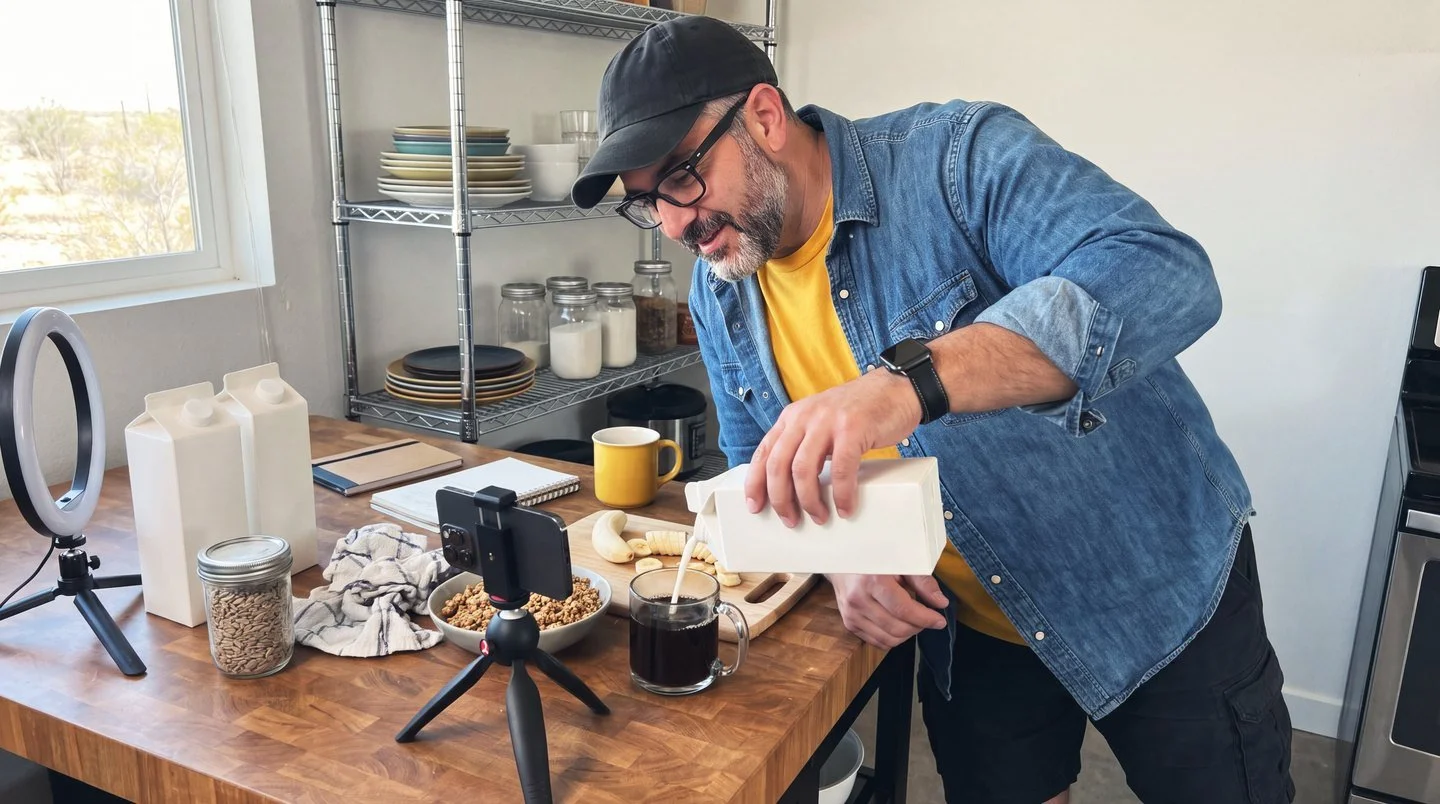
A CPG branding agency builds the identity a packaged food or beverage product sells under: the positioning, the voice, the visual system and the packaging. Before you hire one, ask how the brand holds up at post number 15 in a month. A brand that only works on the carton runs out of things to say by week three.
Key takeaways
A CPG branding agency is usually judged on packaging comps, but your customer meets the brand far more often on a phone than on a shelf.
Repetition is how a small brand gets remembered, and repetition takes volume. The identity has to give a social team enough to post 15 or more times a month without going stale.
Ask every agency on your shortlist to show you a month of posts built from the brand system they're pitching, before you sign.
Lattini, a sunflower milk brand I worked with, was planning 2 or 3 posts a month. We ran 15. Impressions went up 267 percent and engagement went up 120 percent. Followers only went up 2.5 percent, and I'll tell you why that number belongs in the story too.
What is CPG in branding?
CPG means consumer packaged goods, the products people buy often and use up: snacks, sauces, coffee, sparkling water, plant milk, frozen food. In branding, CPG means building a name, a look and a voice for a product that gets picked in a few seconds and has to get picked again every time the carton runs out.
That repeat purchase is the whole game. A software company signs a customer once a year. A sunflower milk brand has to win the same shopper every week or two, in an aisle with a dozen cartons that look a lot like it, and on a phone where the next video is one thumb away. Branding for CPG has to hold up under that kind of frequency. Most of the brand work I've seen was built to hold up in one pitch meeting.
What does a CPG branding agency hand you at the end?
Most CPG branding agencies hand you some mix of the same five. A positioning statement, a brand voice guide, visual identity (logo, color, type), packaging design, and a brand book that explains how to use all of it. Bigger firms add naming, brand architecture across product lines, and launch campaigns.
Look at that list again and notice who it's built for. A printer, a retail buyer and a sales deck. The brand book shows the carton in six colorways and the logo on a delivery truck. It rarely shows what the brand posts on a Tuesday in March when there's no launch, no holiday and nothing new on the shelf.
That's the gap. The agency hands off a beautiful system, the founder hands it to whoever runs social, and that person is staring at a 40-page PDF trying to figure out what to post tomorrow. I wrote about that handoff in what happens the week after the brand book ships. This piece is about the month after that.
Lattini wanted 2 or 3 posts a month. I asked for 15.
In September 2023 I started on social for Lattini, a sunflower seed milk that had just landed on shelves in 10 Erewhon stores in California. The kickoff notes list the plans: a grand opening at the Erewhon in Pasadena, a wellness sampling day the same week, Expo East a few days later. The brand already had a quick brand guide and three messaging pillars: taste, nutrition and sustainability.
They didn't have a feed anyone looked at. On the October 2023 call, someone on the team told me they'd thrown up a couple of posts earlier and got zero engagement. So they stopped. Then someone on their side floated two or three posts a month for the new plan.
I pushed for 15. Two or three posts a month means a shopper who sees one by luck won't see another for weeks. Fifteen gave us room to teach people what sunflower milk is, run recipes and still ask for the sale now and then. We split it roughly 80/20: about 80 percent education, recipes and brand building, about 20 percent sending people to Amazon and the stores. The team agreed to that split on the same call.
Here's what that took from the brand. Fifteen posts a month needs a voice you can write in fast, a look that survives a phone camera in a test kitchen, and pillars wide enough to carry a recipe, a nutrition fact and a farm story in the same week. The brand guide gave us a starting point. The daily work of turning taste, nutrition and sustainability into 15 different posts was where we found out what the brand could carry.
By our January 5, 2024 meeting, Instagram impressions were up 267 percent and engagement was up 120 percent. Net followers were up 2.5 percent. I wrote "need to actively improve this number" right under it on the agenda. The client's 12-month goal was 30,000 new followers, and 2.5 percent is nowhere near that pace. Reach and engagement moved first. Followers lagged. Any agency that shows you only the first two numbers is leaving out the part you'll ask about in month four.
Why does the 3-7-27 rule matter for a CPG branding agency?
The 3-7-27 rule keeps showing up in marketing blogs. See a brand three times and you notice it, seven and you remember it, twenty-seven and you trust it enough to buy. Treat it as a rule of thumb. I read several versions this week. None of them cite a study.
The exact numbers don't matter much. The direction does. Nobody buys a carton of sunflower milk after one look. They buy it after they've seen it in a friend's coffee, then in a store, then in a recipe, then on the shelf again. Every one of those touches has to look and sound like the same brand, or the count starts over.
That's where a CPG branding agency earns its fee or wastes it. If the identity only has one move, a hero shot of the package on a colored background, you'll burn through it by the third post. Your customer will scroll past the fourth because they've seen it. A brand system built for repetition has range: a voice that can be funny about breakfast and serious about ingredients, colors that work in a kitchen and in an aisle, and a few recurring formats the social team can run every week.
The post-15 test: six things to check before you hire a CPG branding agency
Run this on every finalist. A good agency will enjoy it. A weak one will tell you social is a separate scope.
Ask for one month of sample posts built from the brand system they're pitching. Fifteen of them, as rough mockups, not finished art. If the brand can't fill a month on paper, it won't fill one in real life.
Read the voice guide and write three captions yourself. If you can't, your social person can't either. A voice guide should include sample lines, words to use and words the brand never says.
Put the packaging on a phone screen at the size of a thumbnail. Can you tell it's yours? Shoppers will mostly see it that small.
Ask how the identity works in bad light, in a creator's hand and on a store shelf next to your competitors. A brand that only looks right in a studio will look wrong in most of the photos people take of it.
Ask who on their team has run a food or beverage brand's social calendar. A firm that has only made brand books will design for the brand book.
Ask what they'll hand your team on the last day, and whether anyone trains them on it. A PDF is a deliverable. A trained team is a working brand.
Here's how the two kinds of brand system usually compare once they hit the feed.
| Question | Brand built for the carton | Brand built for the feed | |---|---|---| | What does the brand book show? | Packaging, logo lockups, color specs | Packaging plus sample posts, caption lines and recurring formats | | How many visual moves does it have? | One hero look | Several looks that still read as the same brand | | Can a new hire write a caption from it? | Rarely | Yes, on day one | | How does it look on a phone? | Designed at full size, tested on a print proof | Tested at thumbnail size | | What happens in month two? | The team repeats the launch posts | The team runs the same formats with new content | | Who usually built it? | A packaging or design studio | A brand team that has run a social calendar |
Neither column is a bad agency. A packaging studio that builds a great carton has done its job. It just means you'll need someone to build the feed side, and you should budget for that before the carton ships.
How much does an agency charge for branding?
Branding fees depend on scope, so ask every agency to price strategy, identity, packaging and rollout as separate lines. That's the only way to compare quotes, since one firm's "brand package" includes packaging and another's doesn't.
Most CPG branding agencies bill one of three ways: a fixed project fee for a defined job like a rebrand or a packaging system, a monthly retainer with a minimum term, or a sprint with a fixed list of deliverables, often 90 days. Packaging costs climb with every SKU and every dieline. Revision rounds are priced, so ask how many are included.
I don't put prices in articles, because every quote depends on the brand. Here's what I'd tell a founder. Whatever you spend on the identity, set aside money for the first 90 days of using it: the posts, the photos, the recipes, the emails. A rebrand nobody sees is money spent on a file.
What the top Google result for "cpg branding agency" gets right
The number one organic result for "cpg branding agency" right now is a Reddit thread on r/branding. A founder asked for a CPG-focused branding agency with strong food and beverage clients, and most of the replies are agencies recommending themselves. I went through the same thread yesterday when it ranked first for a close cousin of this search, and wrote about hiring the CPG brand agency that asks where people buy.
The useful replies in that thread talk about the shelf: design for the aisle, know your co-packer's limits, build sell sheets a buyer will read. All good advice. None of the replies mention what the brand does after the carton ships, how many times a shopper needs to see it, or who writes the posts. If you're comparing firms, I covered the main types of shop in what a CPG creative agency does and when a food brand needs one.
FAQ
What is a CPG branding agency?
A CPG branding agency is a firm that builds brand identities for consumer packaged goods, mostly food, beverage, personal care and household products. Typical work includes positioning, naming, brand voice, visual identity, packaging design and a brand book. Some also run launch campaigns or social media. Ask which of those they do in house, and ask to see the brand working in a feed, not just on a carton.
What is CPG in branding?
CPG stands for consumer packaged goods, products people buy often and use up, like snacks, drinks, sauces and plant milk. CPG branding builds a name, a look and a voice for a product that shoppers pick in seconds and buy again and again. Because of that repeat purchase, a CPG brand has to stay recognizable across hundreds of touches: the shelf, the phone, a friend's kitchen and the next trip to the store.
How much does an agency charge for branding?
It depends on scope. Agencies usually bill a fixed project fee, a monthly retainer with a minimum term, or a short sprint with set deliverables. Packaging adds cost with every SKU and dieline, and revision rounds are often priced separately. Ask for strategy, identity, packaging and rollout as separate lines so you can compare quotes, and keep budget aside for the first 90 days of using the new brand.
What is the 3-7-27 rule in branding?
The 3-7-27 rule is a marketing rule of thumb: people need to see a brand about 3 times to notice it, 7 times to remember it and 27 times to trust it enough to buy. The numbers vary by who's telling it, and none of the versions I read cite a study. The useful part is the idea that recognition takes repetition, which means a brand needs enough range to show up often without boring people.
Should a food brand hire a CPG branding agency or a social media strategist first?
If you don't have a name, a look or packaging yet, start with a CPG branding agency or a strong design studio, because those pieces have to work together. If the brand exists and the problem is that nobody sees it or remembers it, a social media strategist will usually get you further for the money. Plenty of brands need both, in that order.
What to do next
Open your brand book and try to plan next month's 15 posts from it, alone, in one sitting. Note every place you get stuck: no sample captions, no recurring formats, a look that only works on the carton. That list is your brief for the next CPG branding agency you talk to, and the first thing to ask them about.
I run organic social strategy and content for a handful of food and beverage brands at a time. If you want your brand tested at post 15, DM me on LinkedIn.

adage, emmy, telly & webby award-winning digital marketing consultant for purpose-driven food & beverage brands.