Mike Kurtz Did the Same Demo for Sixteen Years. Kraft Heinz Finally Paid for It. I Counted Mine.
Kraft Heinz put Mike's Hot Honey on Philadelphia whipped cream cheese on September 15. It's the first sweet heat cream cheese Philadelphia has sold in the United States.
It's at Walmart right now. The nationwide rollout waits until January 2027.
Two more flavors shipped the same day. Cranberry Orange for the season, Salted Caramel as a permanent line item.
Read the founder's quote in that announcement. It gives away the entire story. Almost nobody covering the launch stopped on it.
I still see brands reverse-engineer the origin story once the deck is due.
Mike Kurtz didn't bother.
"Philadelphia has been part of the Mike's Hot Honey story since the early days," Mike Kurtz said. "When I was first building the brand, I used to sample our hot honey on bricks of Philadelphia cream cheese to show people just how delicious and versatile the combination could be."
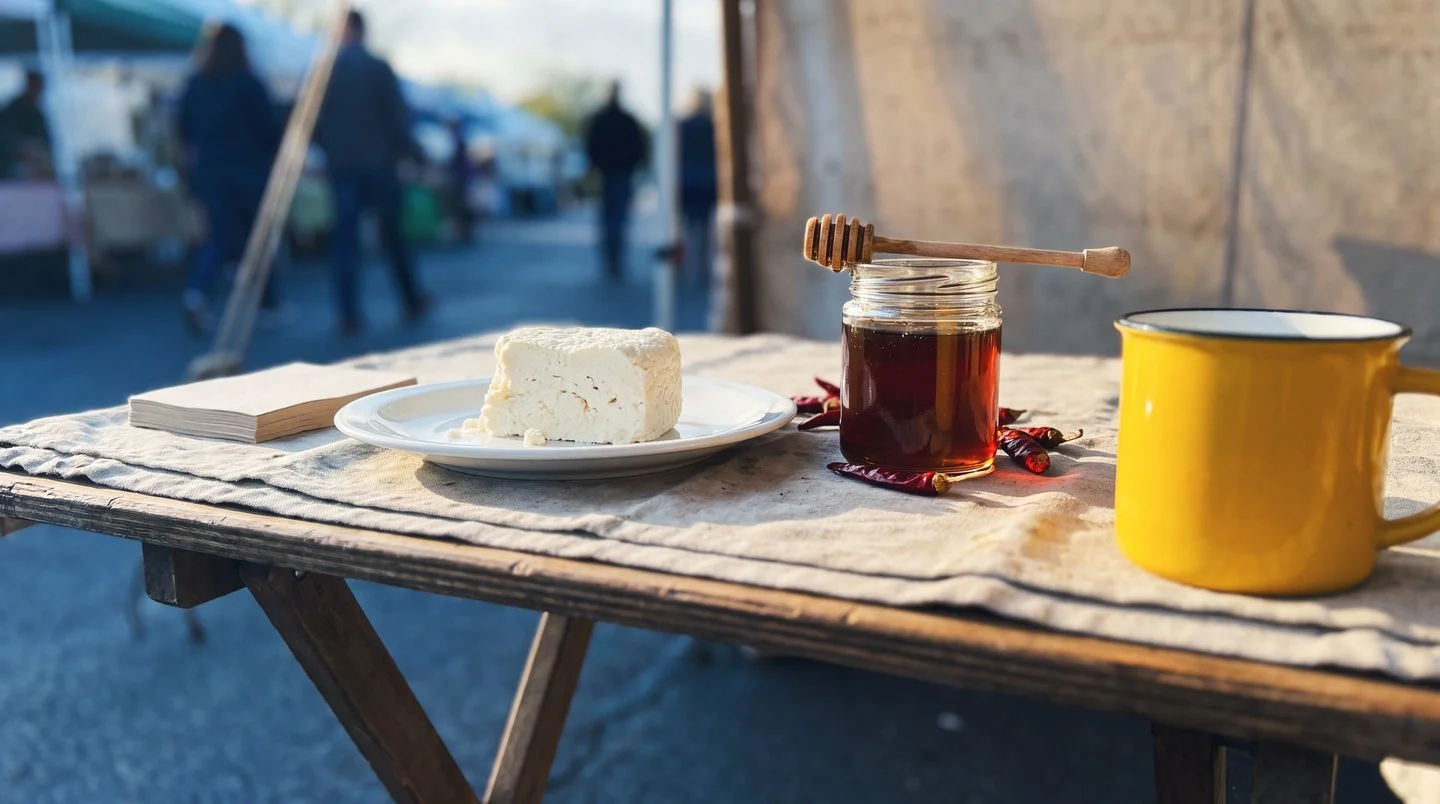
He stood at markets in front of strangers with a brick of somebody else's cream cheese and ran the same demo until it wore thin. Nobody was buying yet. No deal. No co-brand. Barely a label.
He did it anyway. It was the fastest way to make the case, and the case needed making. In 2011 most of America had never heard of hot honey.
Sixteen years later Kraft Heinz put that exact demonstration in a tub and trucked it to Walmart.
What actually changed hands
Kraft Heinz has the plants. It has the trucks. It has a media budget. Reuters said in August the company is putting roughly $700 million this year into innovation and marketing so shoppers pick its brands back up. Kraft Heinz can manufacture almost anything it decides to make.
Sixteen years of a guy at a folding table proving a point. It can't manufacture that.
The recipe wasn't what changed hands. Chili honey was never a trade secret. Plenty of outfits already bottle a version. Grab a stockpot and a strainer and you'll get close by Friday.
Kurtz got the idea in a pizzeria in Brazil in 2004. He spent months testing infusions and gave the jars away as Christmas presents.
Summer 2010 he started drizzling it on pies at Paulie Gee's in Greenpoint. By the end of that year he was selling bottles off the bar.
Whole Foods took it in 2014. Four years from a Brooklyn pizzeria bar to a grocery shelf.
Then twelve more to the Kraft Heinz check.
The company did about $40 million in 2024. Projected at $60 million for 2025.
Read the sequence in order. The slow parts are the point.
Nobody watching in 2011 called that a strategy. It only looks like one from this end because it worked and somebody finally wrote a check against it.
The part still worth something in eighteen months
A demonstration compounds. An assertion evaporates.
Kurtz put the honey on the cream cheese in front of an actual person, and every time he did it he added one entry to a public record. This works. Here's the proof. Watch.
Do that for sixteen years and you're holding something no incumbent can buy off a shelf. The only way to get it is to have been standing there the whole time.
Claims don't stack. "Our honey is versatile" costs nothing to say and nothing to copy. A competitor can publish the identical sentence before lunch. Run that line sixteen years and what you own is sixteen years of the sentence.
This is what organic social media is actually for, and it's the rarest way I see it used.
The feed is the cheapest venue ever built for doing the demo in front of strangers, on repeat, at no cost, with a timestamp welded onto every entry. Most brands use it to run the claim instead. Then they wonder why six years of posting built nothing a buyer can see.
Open your last fifty posts. Ten minutes. It stings.
For each one, decide if it shows you doing something with a result a stranger could check, or if it just tells the reader something.
Count the two piles.
I ran that count on my own archive
I pulled the registry on gallucci.com this morning rather than trust my memory. Memory rounds in your favor.
I've owned it since July 15, 1996. Twenty-five years holding the deed to a piece of land I never built anything on.
The first post on gallucci.net went up July 3, 2021.
I sat on the best demonstration surface I had for twenty-five years and published nothing on it. Kurtz worked a folding table and a brick of cream cheese. I had a domain and a login.
438 posts on the site now. The headlines say what they are.
Twenty-five of the 438 titles carry a first-person marker. An I, a my, a we.
That's 5.7 percent.
Forty-eight contain a number of any kind.
Six do both.
Six out of 438.
Six headlines that named one specific thing I did and then dropped the real number that came out of it.
Scroll 438 of my headlines and you get told a great deal and shown very little.
That's a title count, not a body count. A post can demonstrate plenty under a tidy headline. Several of mine do.
The headline is still the part a stranger reads.
The ones that hold up are the ones where I was standing at the table. How I helped Topo Chico become a sparkling water sensation in the U.S. is a demonstration, because it names what I did and what happened. Why we said no to the Kardashians and still ended up in Vogue is a demonstration, because there's a decision in it with a consequence attached. Lo-fi founder talking-head beats 4K production is one because I ran the comparison myself instead of quoting somebody who ran it. The other 430-odd are a mix, and a lot of that mix is me being useful in a way that could have come from anybody.
One caution, because this cuts both ways
Mike's Hot Honey just landed on a Kraft Heinz cream cheese. Before that it was Ewing Athletics cross-trainers, doughnuts at Dough, deep dish at Lou Malnati's, ice cream at Cold Stone, cookies at Insomnia, frozen pizza with DiGiorno and California Pizza Kitchen, and almonds with Blue Diamond.
Every one of those spends a little of the credibility the folding table built.
A few more and the name stops being a brand. It reads like a flavor descriptor.
That's the quiet risk in licensing a demonstration. The thing nobody could buy ends up sold in pieces.
None of the individual pieces looked like a mistake on the day it was signed.
Whipped cream cheese with infused honey is not a clean-label product.
The founder story doesn't get to carry claims the ingredient deck can't back.
What I'd do about it this week
If your plan for next year is a content calendar and none of it is a repeatable demonstration with a number attached, you've written a claim and scheduled it fifty-two times.
Fix one thing. Pick something you actually did in the last thirty days that produced a result you can check. Write down what you did and what came out of it. Publish that. Then do it again in thirty days.
Two entries is an anecdote. Twenty is a record. Sixteen years is a Kraft Heinz check.
That's an entire organic social media plan and it fits on an index card. Brands skip it for one reason. The first eleven entries look like nothing, and most marketing budgets can't survive looking like nothing for eleven months.
When a brand hires me, most of the work looks like that. The first month I'm usually just finding the demonstrations the company already runs every week and never films.
That's the real argument for hiring a food and beverage marketing agency over a content vendor. A vendor produces claims on a schedule. The demos are already happening in your warehouse, on your line, at your farmers market table. They're free.
Kurtz walked into 2011 with a brick of Philadelphia. No strategy. Just the product and the patience to keep bringing it back.

adage, emmy, telly & webby award-winning digital marketing consultant for purpose-driven food & beverage brands.