Why Your Better-for-You Snack Brand's Content Isn't Converting (And How to Fix It)
Better-for-you snack brands spend thousands on content creation: video shoots, influencer partnerships, professional photography, copywriting. Then the content performs fine on metrics (likes, shares, comments) but drives minimal actual sales.
I see this pattern with nearly every brand I work with. The content looks clean-label. The messaging checks the boxes: organic, non-GMO, no artificial ingredients. But something's missing. Customers swipe past. Retail buyers ask for numbers they've already seen from five other competitors.
The problem isn't effort. It's that most better-for-you snack brands have outsourced their voice to influencers, agencies, or content mills. This works for conventional snacks. It fails for clean-label. Because transparency is the entire product story. When a customer chooses your $6 organic granola over a $3 competitor, they're paying for credibility. They want to know the founder believes it too.
The Founder Credibility Gap
Conventional snack brands succeed on scale, distribution, and convenience. Better-for-you brands win on trust and transparency. Those require founder voice.
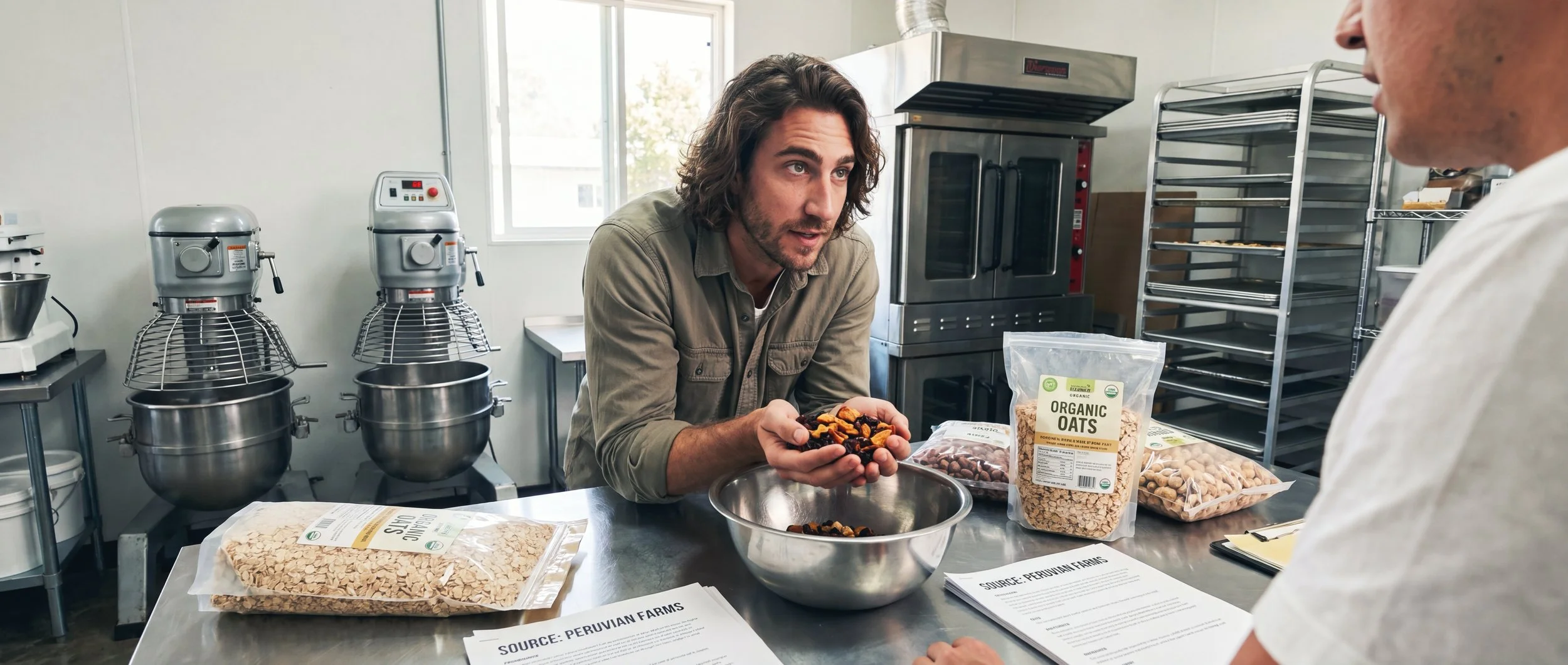
Here's what I see across my clients: the brands with the highest conversion per-impression have one thing in common. The founder appears in content. Not as a logo or an "about us" story buried on the website. In their feed. Talking about why they chose a supplier, what they rejected, why the ingredients matter.
One client, a nut-butter brand, was getting 1.3% conversion on social traffic. Heavy influencer spend, gorgeous product shots, zero founder presence. We rebuilt their content calendar to feature the founder talking about how they tested 40 suppliers before landing on their current nut roaster: a family business in California that hand-roasts in small batches. Conversion jumped to 4.1%.
That's not a viral campaign. It's founder-led content. It's different from what every other snack brand puts out.
The conventional wisdom is that brands should be consistent, professional, polished. Faceless. Algorithmic. But in clean-label, "professional" is a liability. Customers are actively choosing against corporate snack companies. They want to know a real person stands behind this. Algorithms don't stand behind anything.
Why Better-for-You Content Needs a Different Strategy
Most snack brands run a single social presence for both DTC customers and B2B buyers (retail partners, food service, corporate accounts). This is a strategic error.
A consumer on Instagram wants to know: Does this taste good? Will it help me? Can I trust the ingredients?
A retail buyer wants to know: Will this sell? What's the margin? Why should I stock this instead of three other clean-label snacks?
The content that answers one question fails to answer the other. So most brands optimize for the consumer (higher volume, more visible), and their retail content suffers. Or they run one generic feed and bore both audiences.
This is why content creation for better-for-you snack brands requires segmentation, not volume.
The Founder Velocity Framework
I built this framework after seeing the same mistake across 30+ clients. Founder Velocity measures content effectiveness by mapping every piece to one of three buyer journeys.
Velocity 1: Founder Trust (DTC, high-consideration buyers). Direct-to-camera, founder speaking to why the brand exists, supply-chain choices, rejected ingredients, testing stories. This content has the lowest view counts but the highest conversion and highest lifetime value. Goal: prove founder credibility. Platforms: Instagram Reels, YouTube, LinkedIn.
Velocity 2: Product Story (DTC, lower-consideration, impulse-driven). Visual, lifestyle, use-case focused. Where and how to eat the snack. Pairs with UGC (user-generated content) from real customers, not influencers. Goal: normalize the product, build desire. Platforms: TikTok, Instagram, Pinterest.
Velocity 3: Differentiation (B2B, retail and food-service buyers). Specification sheets, certifications, sourcing maps, supply-chain transparency, margin story, sell-through data. Founder isn't the angle. Proof is. Goal: give retailers confidence. Platforms: LinkedIn, email, private channels with buyers.
Most better-for-you brands run this ratio:
80% Velocity 2 (pretty product content)
15% Velocity 1 (founder credibility)
5% Velocity 3 (retail support)
This ratio is backwards.
For founder-led clean-label brands, it should be:
40% Velocity 1 (founder credibility)
40% Velocity 2 (product story)
20% Velocity 3 (retail differentiation)
Why. Because founder credibility is the only thing that can't be copied. Every other snack brand can hire a food scientist to create a similar product. One brand can't hire the founder of another brand. Founder voice is sustainable competitive advantage.
How to Implement Founder Velocity in Your Content
Actionable steps to rebalance your content.
Audit your current feed. Pull your last 20 posts. Which Velocity bucket does each one fall into. If you're 80% Velocity 2, you know what needs to change.
Assign founder content days. Pick one day per week for founder-led content. This doesn't require a full video shoot. A 60-second phone video of the founder talking about a sourcing decision. A caption about why they rejected a cheaper ingredient. A founder Q&A response to a customer DM. Consistency beats production value.
Separate your channels by audience. If you have 50k DTC followers and 2k retail buyers following, your B2B content will never win the main-feed algorithm. Create a separate LinkedIn presence for B2B outreach. Send retail updates via email or direct Slack channels. Stop optimizing for one audience.
Build content around supply-chain stories. These are free. You already have them. A supplier change. A sourcing trip. A crop that didn't meet standards. Rejected ingredients. Founder-led supply-chain content is credible, specific, and different from competitors.
Use customer reviews and UGC. Repost customer photos and reviews (with permission). Tag customers. This is cheaper than influencer partnerships, more credible, and it puts real users in front of your audience instead of paid talent. Better-for-you buyers trust other real buyers more than influencers.
FAQ: Your Questions on Founder-Led Content
Q: How do I scale founder-led content if the founder is running the company day-to-day?
A: You don't scale it. You batch it. One hour per week where the founder records five 60-second pieces, or answers customer DMs and pulls them into content. You don't need founder content daily. You need consistency. Once per week is enough.
Q: Won't constant founder visibility get boring or repetitive?
A: Only if you're repeating the same message. The topic stays the same (supply chain, founder perspective), but the story changes. This week: why you changed suppliers. Next week: an ingredient you almost used but rejected. The week after: a customer DM about sourcing. Boring is generic. Specific founder takes are endlessly interesting to a loyal audience.
Q: Does this work for quieter founders or only those with big personalities?
A: Personality helps, but it's not required. Credibility is. A quiet founder who knows sourcing deeply and speaks clearly beats a charismatic founder who's vague about ingredients. Pick the strongest angle of the founder's background and lead with that.
Q: What about influencer partnerships? Do I eliminate them?
A: No. Rebalance. If you're spending 50% of content budget on influencers, move to 20%. Use influencers for Velocity 2 (product awareness), not Velocity 1 (founder credibility). Influencers can't replace founder voice.
Why This Matters Now
Better-for-you snacks are crowded. Organic, non-GMO, no artificial ingredients are now table stakes. Every brand has them. Every brand can get the same certifications, source from the same farms.
The only thing that can't be copied is founder credibility. Not the product story. Not the origin story. The founder, showing up, being visible, speaking honestly about their choices.
Content creation for better-for-you snack brands isn't a marketing tactic. It's a business requirement. It's how you sustain premium pricing when every competitor can copy your recipe.
I help clean-label food brands build real organic communities through strategy, content, and brand storytelling. If your content feels busy but ineffective, that is the problem I fix. Follow me @gallucciNET on social media.

adage, emmy, telly & webby award-winning digital marketing consultant for purpose-driven food & beverage brands.