CPG marketing agency: count the hands between your brief and your feed
A CPG marketing agency plans and makes the marketing for packaged food, beverage and household brands. Before you sign one, count the people who touch a single post between your brief and your feed. Ad agency staff turn over at 18 to 25 percent a year, and every extra hand files a little more of your voice off.
Updated November 11, 2026.
The short version
- Ask for the name of every person who touches one post, from brief to publish. Write the number down.
- Five to seven hands is normal at a mid-size shop, and it's where a founder's voice turns into category-speak.
- Agency staff turnover runs 18 to 25 percent a year, so the team in the pitch is rarely the team in month nine.
- Small shops keep fewer hands but lose clients faster (32 percent a year at 1 to 10 employees), so ask about capacity.
- Price the hands. A retainer quote that won't name who does the work can't be compared to anything.
What does a CPG marketing agency do?
A CPG marketing agency handles some mix of brand strategy, packaging, social content, paid media, creator programs and retail marketing for consumer packaged goods. The mix changes from shop to shop, and so does the number of people they put between you and the finished work.
I wrote the first version of this guide in October, on how to read a pitch when it shows up in a Reddit comment thread. That thread still sits at the top of Google for "cpg marketing agency" as of November 11, 2026, and it's still mostly agencies recommending themselves. The ranking lists underneath it have the same problem, since most of them put the author's own agency first. This piece walks one step further down the hall, to the part of the agency you don't meet in the pitch.
How many hands touch one post at a typical CPG marketing agency?
In my experience, a single Instagram post at a mid-size agency passes through five to seven people before it goes live. That count is no scandal. Agencies staff accounts that way so nobody's out sick and the work keeps moving. It is a cost, though, and nobody puts it on the invoice.
A typical chain, as I've watched it from the client side:
| Hand | What they add | What they tend to sand off |
|---|---|---|
| Founder or brand lead | The brief, the story, the odd detail only you know | Nothing yet |
| Account manager | Timelines and the approval tracker | The odd detail, because it didn't fit the brief template |
| Strategist | Audience, content pillars, the calendar | Anything that doesn't map to a pillar |
| Creative director | Taste and the concept | Lines that sound like you and not like the agency's portfolio |
| Copywriter and designer | The post itself | Whatever the last three people asked them to cut |
| Community manager | Replies, comments and DMs | The tone of the post, because they weren't in the room when it was written |
| Your approval loop | Legal, sales, the co-founder | The last sharp sentence |
That's seven. Every one of them is doing their job. And by the end, the caption reads like nobody in particular wrote it. That's the committee-approved paragraph, the exact thing an independent food brand is supposed to be beating on the shelf.
Why does every extra hand cost you voice?
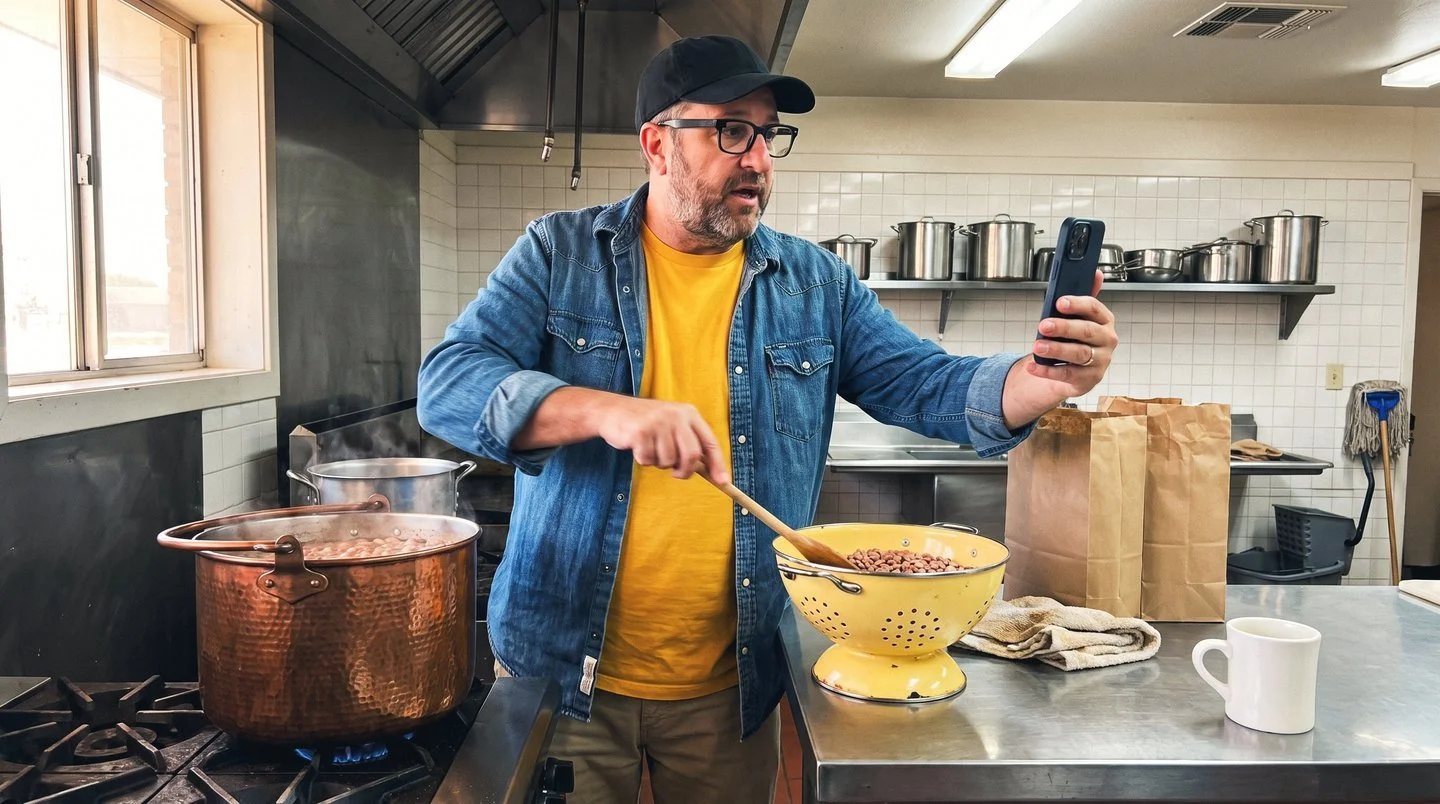
Each handoff loses some of the context the last person had. A founder says "we cook the beans in the same copper kettle my grandmother used." The account manager writes "heritage process." The strategist files it under the authenticity pillar. By the time it reaches the copywriter, it's "made the old-fashioned way," and that line could sit on any bag in the aisle.
Turnover makes it worse. NetSuite puts advertising agency turnover at 18 to 25 percent a year, down from about 30 percent in recent years, with junior and mid-level roles cycling every one to three years. Those junior and mid-level people are the copywriters and community managers closest to your feed. On a six-person team, one or two hands will likely be new within a year, and the new ones learn your brand from the brief instead of from you.
The big holding companies are cutting those teams, too. Agency Mania's 2026 revenue roundup reports that the four largest holding companies shed a net 11,689 employees in 2025, and that Forrester forecasts a further 15 percent headcount cut in 2026. From what I've seen, smaller teams keep the same chain of handoffs, with each person spread across more brands.
The cheapest fix sits on your side of the table. If you haven't written your voice down, write the rulebook before you hire, because every hand on that chain will read it and none of them will have met your grandmother.
What I saw from the brand side of the table
I spent six years at Frito-Lay as a content creator, videographer and video editor, then nearly six years leading social strategy at Coca-Cola. I sat through a lot of agency reviews. The posts that worked came from the shortest chains: one strategist who'd been on the account long enough to know the product, a writer who'd talked to the people who made it, and a client who approved without rewriting.
The posts that flopped usually had the cleanest decks. Every layer signed off. Every pillar covered. The copy could've run for any brand in the category.
Now I run it the other way. I make food and beverage content out of Marfa, Texas, with an archive of more than 435 posts on gallucci.net (a domain I've owned since 1996), and I work on an AI production pipeline so one person can carry a post from the founder's sentence to the published feed. Hands on the work: me and you. That choice has trade-offs, and the next section is the honest part.
Does a smaller shop fix the problem?
A smaller shop cuts the hands, but it brings a different risk, and you should price both. Focus Digital's 2026 churn report puts annual client churn at 32 percent for agencies with 1 to 10 employees, against 15 percent for agencies with 51 or more. Its explanation is founder dependency. The whole relationship rides on one person's time.
That tracks with what I see. A one- or two-person shop keeps your voice intact right up until it signs too many brands. So ask how many brands they're carrying this quarter, and what happens when they're out for a week. I've written before about what you get when you ask for one person and Google hands you a holding company. The flip side is a solo shop that says yes to everybody.
I keep my roster to a handful of food brands a quarter for that reason, and I tell people before we start what's in my lane (organic social strategy and content production, plus SEO and GEO) and what isn't (I don't run paid media).
The big shop has the opposite profile. More hands, lower churn, more process. Pick the risk you can live with, after you've counted.
What does a short chain look like week to week?
A short chain means the person who hears the founder is the person who writes the post. On a typical week with a two-hand setup, the founder sends a voice memo on Monday about whatever happened on the line or at the store. On Tuesday that memo turns into drafts, in the founder's own words wherever they hold up. On Wednesday the visuals get made. On Thursday one person on the brand side approves. Friday it posts.
Nobody rewrites the founder's sentence into a pillar. Nobody new joins halfway through and asks what the brand sounds like. When a retailer calls about a reset or a co-packer slips a run, the change reaches the feed the same week, because there's no tracker it has to pass through first.
That setup won't fit every brand. A national launch with paid media, retail media and a sampling tour in six markets needs more hands, and a bigger CPG marketing agency is the right call there. Most independent food and beverage brands I talk to aren't running that launch. They're trying to sound like themselves three times a week.
How much does a CPG marketing agency cost?
Retainers for emerging CPG brands run roughly $8,000 to $75,000 a month, going by one agency's published 2026 ranges. Cool Nerds Marketing's 2026 guide puts project work at $15,000 to $150,000 or more, scaled-brand retainers at $75,000 to $300,000 or more a month, and performance media fees at 10 to 20 percent of media spend. The same guide says a full-service retainer is usually overkill under $1 million in annual revenue.
Treat those as one agency's numbers, published to sell its own services. The more useful exercise is dividing the quote by the hands. A $20,000 retainer split across seven people buys a few hours a week from each of them, and a chunk of those hours goes to handoffs and status calls. Ask for the quote by person and by role. If they won't break it out, you can't tell what you're paying for. And while you're at it, ask what's left when the ad budget stops.
Five questions to ask a CPG marketing agency before you sign
- Who touches one post, by name and role? Done when you have a written list and a number.
- Who on that list has met someone who makes the product? Done when at least the writer has, or there's a date on the calendar for it.
- How long has each person been on their current accounts? Done when you know whether the team in the pitch tends to stay.
- Who can approve a post without sending it back up the chain? Done when one name on their side and one on yours can sign off.
- How many brands is each person carrying this quarter? Done when you get a number, and the answer isn't "it varies."
FAQ
What is a CPG marketing agency?
A CPG marketing agency is a firm that plans and produces marketing for consumer packaged goods brands, such as packaged food, beverages and household products. Most handle some mix of brand strategy, packaging, social content, paid media, creator programs and retail marketing. The useful question for a founder is which of those jobs the agency does in-house, and how many people sit between your brief and the finished work.
What are the big 3 marketing agencies?
The three largest advertising holding companies by revenue are Omnicom, WPP and Publicis Groupe. Omnicom moved to number one after it finished buying Interpublic at the end of 2025, its first time at the top since 2008, according to Agency Mania's 2026 roundup. Most agencies a small food or beverage brand talks to are independents, well outside those three.
How many people should work on my brand's social account?
Fewer than most proposals show. For a small or mid-size food or beverage brand, two or three people who know the product usually beat a seven-person chain where most hands never taste it. What counts is that the person writing the posts has talked to whoever makes the product, and that one person on each side can approve without a committee.
How do I keep my brand voice with an agency?
Write the voice down before you hire, keep the chain short, and make sure the writer has met the people who make the product. Agency turnover of 18 to 25 percent a year means someone new will learn your brand from documents, so those documents need your own words in them. Then review the first month of posts against your own sentences.
Should a small food brand hire an agency or keep social in-house?
Under about $1 million in annual revenue, most brands do better with project work or a small specialist than with a full-service retainer, a point even agency-published pricing guides make. Keep the founder's voice in-house as the source, and hire out the production and strategy you can't staff. Past that size, count the hands before you count the deliverables.
What to do this week
Pull up the last three proposals you got from a CPG marketing agency, or the next one that lands. Write down every role named in the staffing section and count them. Then ask each shop the five questions above and lay the answers side by side before you compare the creative.
Used AI to draft and edit this. Checked every number against the sources linked above.
I do this for a handful of food brands a quarter, with two hands on the work. If you want yours to be one of them, message me on LinkedIn.

adage, emmy, telly & webby award-winning digital marketing consultant for purpose-driven food & beverage brands.