AdExchanger Just Saved You a GEO Retainer
This week someone put it to the people selling answer-engine optimization: does any of it work? They answered honestly. I didn't see that coming.
AdExchanger ran Joanna Gerber's piece on September 10. She opened with the Socrates line about knowing nothing. That was the real position of nearly every company selling AI search visibility for most of the past year. You ask why one page gets cited and another doesn't. Nobody knows.
Aniket Deosthali runs Envive. It's an AEO company. He told AdExchanger the major models "are black boxes." His words. On the exact thing his shop charges clients to optimize.
That's the seller talking. Not a critic. Not a skeptic with a newsletter. The seller.
What else is in that piece
The Reddit play fell apart in public and almost nobody noticed.
For a stretch the move was get your brand mentioned there because the models leaned on it hard. Prompt Watch had Reddit at roughly 3.83 percent of ChatGPT citations from July 18 through August 7. By mid-August it was sitting around 0.5 percent.
First drop hit August 8, same day ChatGPT stopped scanning the open web and narrowed toward specific sites. Second one landed August 14. Nobody's explained that cut.
Shafqat Islam, president of Optimizely, told AdExchanger the Reddit-stuffing play "violates the most sacred principles of Reddit."
Reddit's own spokesperson put it plainer. The company questions the legitimacy of any vendor that claims it can guarantee model performance through Reddit posts.
Noble emails publishers and asks them to rewrite live articles so a client shows up in the copy. That's the whole product.
The outreach is automated. Rahul Jain, Noble's CEO and co-founder, confirmed to AdExchanger that the emails go out under made-up names, invented across various genders and ethnic backgrounds, to make the ask feel personal. Response rate runs 4 to 10 percent.
One ad tech executive, speaking anonymously, said his company quit after two weeks because publishers pushed back. "I don't want to tarnish my brand by doing spammy outreach," he said.
A bot with a made-up ethnicity hits an editor's inbox and asks them to slip your brand into a listicle. In 2026, that's a paid marketing tactic.
Islam closed the piece with four words. "Just do all the SEO stuff, and you'll be fine."
I put that in writing in July
On July 1 I locked in a long-form content rule for everything I write. One line in it is plain: there is no separate AEO or GEO game. Optimizing for AI search is just good SEO plus content that isn't a commodity.
I wasn't being clever. Google published the guidance. Their AI search features run on the same ranking and quality systems as regular search. I took them at their word and wrote it down.
Ten weeks later the president of Optimizely says the same thing to a trade reporter. A room full of funded vendors nods along.
I'd also published a piece called GEO Is the New SEO (And Most Brands Are Clueless) before any of this had a vendor category attached to it. The advice in it was answer real questions, go long and structured, write for machines and humans at the same time, and redeploy the same asset across every surface where discovery happens. Boring. Still correct. Nobody can sell you a dashboard for it, which is most of the problem.
Now the part with numbers in it
Uberall and Search Engine Journal ran more than 120,000 AI mentions across 3,793 business locations.
Five models. ChatGPT, Gemini, Claude, Grok, Perplexity.
They wanted to know what actually gets a model to name a business when somebody asks for a recommendation.
Market share wasn't a factor.
Review volume predicts AI mentions. That held across all five verticals they studied.
Star ratings came in weaker in four of the five. When ratings registered at all, they still weren't what drove visibility.
For dentists, no star rating on any platform reached statistical significance.
Photo count was the finding that got less attention. It's the one I keep thinking about.
It was the number-one predictor of how often a restaurant got mentioned. Strongest signal in dental. Third most important for banks.
Search Engine Journal's call is 100 or more quality photos across your locations. Restaurants and hotels chasing top placement need 2,000 or more.
Upload them in steady increments. Don't dump the whole set at once. A business that adds photos every week reads as alive.
Ask people to leave reviews. Go take a lot of pictures. Those two were the strongest measurable levers in the study.
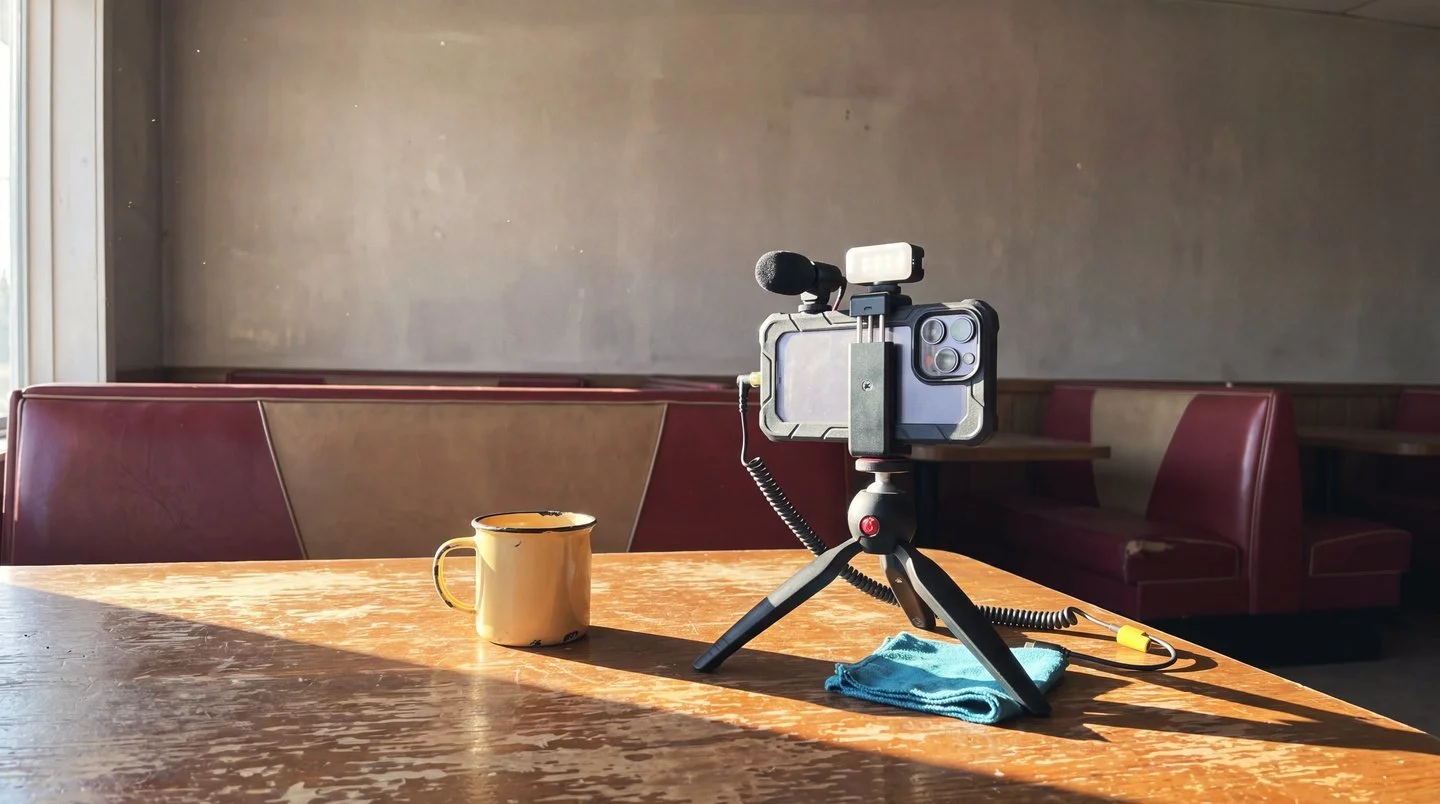
I have been shooting for thirty years. Most of it now on a rigged iPhone. I can tell you what two thousand photographs of a restaurant costs, and it is not a retainer, it is a couple of long afternoons and somebody who knows where the light is at four o'clock. This is the same unglamorous production work that organic social media has always run on, which is exactly why the software category doesn't want to talk about it. There's no recurring revenue in telling a client to go outside. It's the same argument I've made for years about social media marketing for clean-label brands, where the thing that builds belief is showing the farm, the facility and the founder, over and over, until the audience knows your story better than your competitor's.
What to put in the contract
Digiday reported it this week. Agencies aren't rewriting the master services agreement for AI. They're bolting clauses onto the ones they already have.
Scott Shamberg, president and CEO of Mile Marker, said it plainly: "We are at the point now where we are just simply working that into existing MSAs."
The tweaks cover who owns the IP on AI-generated output and what tools get disclosed. Four agency executives told Digiday the same thing. None of them are ready to overhaul the contract.
Put the AEO admissions next to the contracts. There's the real exposure. A category that can't prove its methods is selling into paper nobody rewrote for the day those methods don't work.
Sellers aren't in a hurry. Fix it on your side.
Don't buy AEO on an annual retainer priced off the fear you'll vanish from ChatGPT. Buy it test-and-measure, with a hard end date and a kill clause.
Ask which models sit in the composite score and at what weight. Then reweight it to where your buyers actually are.
Greg Jarboe said it at Search Engine Journal this week: giving Perplexity the same weight as ChatGPT, Gemini, and Claude warps the number before anyone reads it. He's right.
Most pitches die on the next question. What business outcome sat behind your last visibility number?
Freshpet is the case study this category leads with. Look at it straight.
Intero Digital reports a 645 percent lift in Freshpet's appearances in Google AI Overviews. That's the agency's figure on its own work. Doesn't make it false. Makes it a claim, not an audit.
In the Search Engine Journal webinar on that program, Freshpet's Steven Elwell said direct revenue attribution is hard for them. The brand's site sends most customers off to retailers.
The subscription side is measurable. The rest isn't, cleanly.
Most honest thing anybody said in the category this week came from the client. Not the vendor.
I've spent years as a food and beverage marketing agency of one, and the pattern doesn't change. Whenever a new channel shows up that nobody can measure, a layer of people appears to sell measurement of it. Some of them are good. The tell is whether they'll put the business outcome in the scope document or only the score. I wrote a while back about why most food branding agencies miss the real problem, and it's the same failure wearing new vocabulary: charging like you're solving the problem while solving a different one.
Before you sign anything, spend one quarter on the two levers that study actually found.
Ask every real customer for a review.
Photograph every location until you've got a hundred images that don't look like they came off a stock site.
Run both the way you'd run an organic social media program. Put it on a calendar. Make somebody accountable for the count.
Those assets are yours forever. Neither one gets repriced when a model changes how it crawls in August.
If the pitch can't tell you what moved after the number went up, the number was the product.

adage, emmy, telly & webby award-winning digital marketing consultant for purpose-driven food & beverage brands.