AI content strategy for CPG food and beverage brands: run it like your HACCP plan

Build your AI content strategy for CPG food and beverage brands the way your plant builds a HACCP plan. Name the hazards, set the control points, set the limits, and keep the records. It's a written plan for where AI makes your content and where a person has to check it before it ships.
The short version:
Your plant already knows how to keep a hazard from reaching a shopper. Content needs the same seven moves, written down.
AI can hold research, first drafts, versioning and resizing. A person holds product truth, claims, faces and the final read.
Measure a yield rate. Count how much AI output survives the check, and what it costs when it doesn't.
The control point that matters most sits between drafted and published. Most brands don't have one.
What is an AI content strategy for CPG food and beverage brands?
It's the rulebook for how AI touches your brand's content, from the first research pull to the post that goes live. It names every place a model works, every place a person signs off, and what counts as a reject.
Most of what ranks for this phrase is a trend list. Personalization is coming. Short-form video matters. Social listening is getting smarter. All true. None of it tells a founder what to do on Monday. A trend list describes the weather. A CPG operator needs a plan for the plant.
I've run AI inside my own content operation out of Marfa, Texas for years, and I was putting generative tools to work on Topo Chico content well before most agencies had a policy for them. The lesson from all of it fits on a napkin. AI made content cheap to produce. It did nothing to make a bad post cheaper to publish.
Why do most CPG brands stall on AI content?
They bought tools before they wrote rules. BCG's survey of CPG marketing leaders found seven in ten expect generative AI to make their teams faster, yet only 13 percent said it was in widespread use or fully built into their marketing workflows.
That gap isn't a software problem. A brand team with three AI subscriptions and no written standard ends up with a junior marketer making judgment calls on claims, likeness and tone at four in the afternoon on a Friday. Sometimes the call is fine. Sometimes a rendered bag of chips looks better than the one leaving the co-packer, and nobody notices until a shopper does.
You already solved this problem once, in a different building. Your QA team doesn't assume every batch is safe. They decided in advance where things go wrong, what the limit is, who checks, and what happens when a check fails. Content can borrow that whole structure.
How do you build an AI content strategy for CPG food and beverage brands with HACCP?
Map the seven HACCP principles onto your content line, one for one. The FDA lists them as hazard analysis, critical control points, critical limits, monitoring, corrective actions, verification, and record-keeping. Each one has a direct content version.
Hazard analysis. List what can go wrong when AI touches your content: an invented claim, a product that looks better than the real one, a face that belongs to nobody, a quote changed by one word, a keyword sanded out of a headline.
Critical control points. Mark the steps where a hazard can still be stopped. For most brands that's three: the brief, the product image, and the final read before scheduling.
Critical limits. Write the pass or fail line for each point. Zero rendered product. Zero unsourced health or nutrition claims. Every number traced to a source.
Monitoring. Name who checks each point, and how often. A name, not a department.
Corrective actions. Decide in advance what happens to a reject. It goes back to the model once, then a person rewrites it or it dies.
Verification. Once a month, pull ten published posts at random and audit them against the limits, the way QA pulls retained samples.
Record-keeping. Log every rejected draft and why it failed. That log becomes your yield rate and your training file.
Seven steps sounds heavy. It's two pages for most brands. The first version takes an afternoon.
Which content jobs should AI hold, and which stay human?
Hand AI the volume jobs where a mistake is cheap to catch. People hold anything a shopper will take as true about your food.
| Station on the content line | AI holds | A person holds | |---|---|---| | Research and social listening | Summarizing comments, reviews, search terms | Deciding which signal is worth a post | | Briefs | First draft of the brief | The angle, the claim, the ask | | Copy | Drafts, variants, length edits | Final read, every number and quote | | Product imagery | Backgrounds, props, the room | The product itself, shot for real | | People on camera | Nothing without a disclosed label | Real founders, real staff, real customers | | Versioning and resizing | Cuts for each platform | Spot check before scheduling | | Reporting | Pulling numbers, a first pass at patterns | What changes next month |
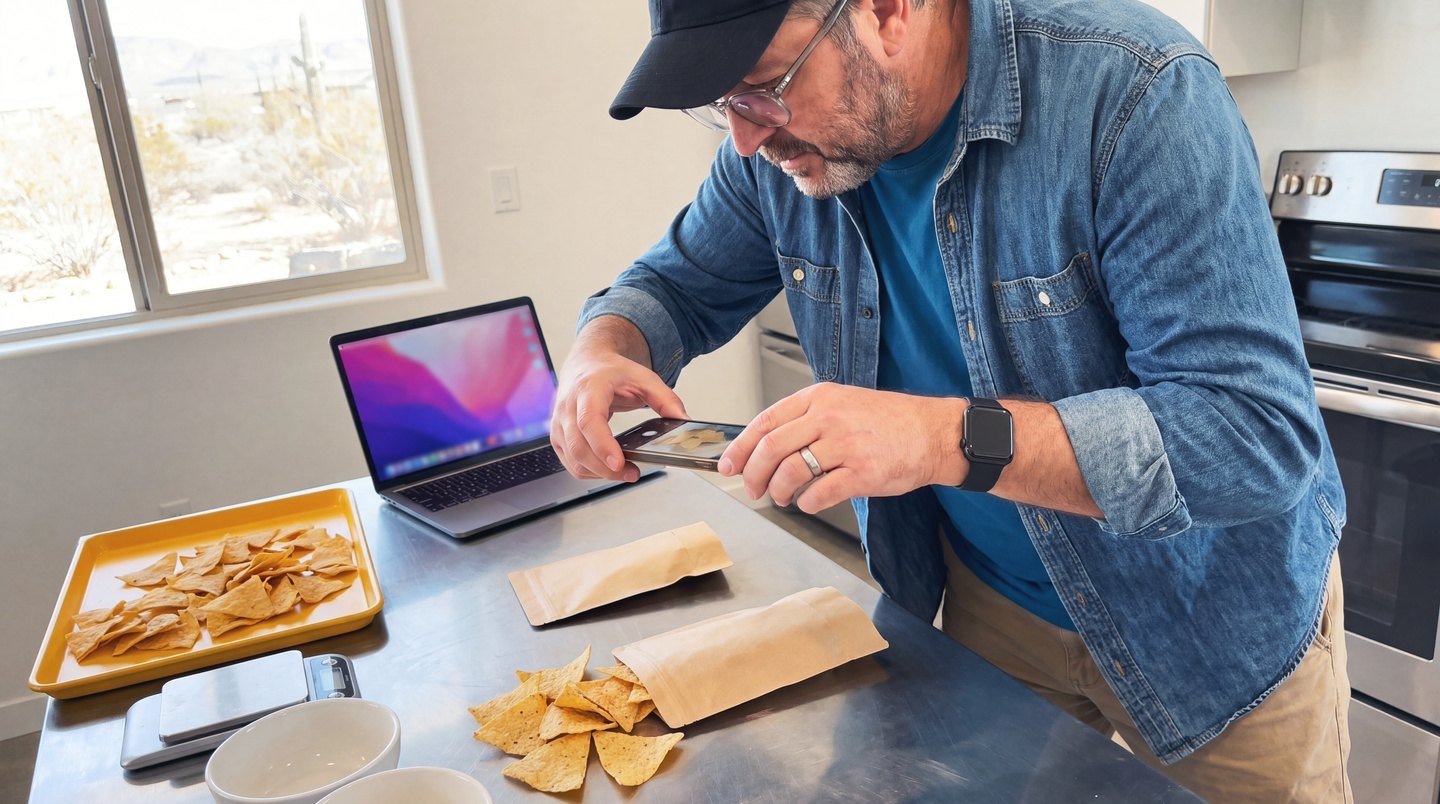
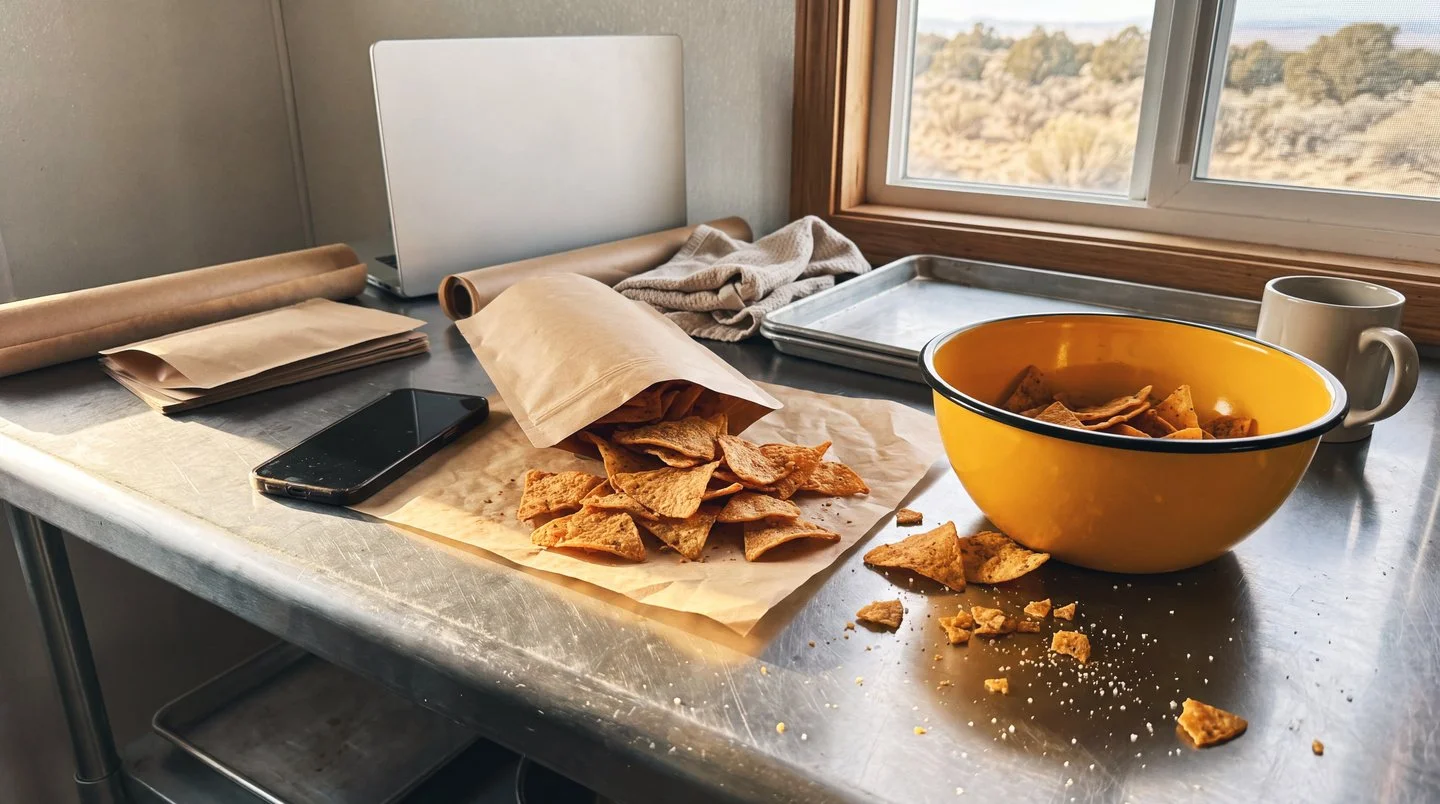
The product row is where I draw the hardest line. I shoot the real chip, bar, or can on a rigged iPhone 14 Pro Max and let AI build the room only when that room doesn't exist. What leaves the plant stays what leaves the plant.
The people row moved this year. Instagram now labels profiles built around an AI-generated person, and I went through that exercise on my own roster when I had to label my synthetic personas. Shoppers read faces as testimony. The FTC's 2024 final rule bans fake reviews and testimonials outright, AI-generated ones included, and it lets the agency seek civil penalties.
What does a good yield rate look like for AI content?
Nobody publishes an industry benchmark on this. You set your own. Yield is the share of AI output that clears your critical limits without a person rewriting it.
I log mine. September's humanizing pass hit 394 paragraphs across nineteen articles, rewrote 374, and threw out 20 for $34.47 total. That's about $1.81 an article. I wrote up the full breakdown when I priced my own AI content line. Cost was never the problem. The 20 rejects were. Nine dropped a link. Seven changed words inside a quotation. Two slipped in banned punctuation. A mechanical check caught every one of those. It can't catch a sentence that says something your brand would never say. That's the reject that costs you.
Track two numbers. The share of drafts that pass on the first try. The count of mistakes that still made it to a live post. First one shows if the line runs efficient. Second one shows if you've got a line at all.
Where does AI content strategy go wrong for food brands?
It goes wrong when the AI part becomes the product. I've covered the biggest mistake CPG brands make with AI content strategy before. They scale volume when they should scale credibility. The HACCP frame fixes the mechanics of that. Volume stops counting the moment rejects get logged.
Three failure patterns show up again and again:
Selling the AI. Washington State University researchers surveyed more than 1,000 U.S. adults and found that putting the words "artificial intelligence" in a product description lowered purchase intent, driven by lower emotional trust. Use AI in the kitchen. Don't print it on the menu.
Renting a voice. A model trained on everybody writes like nobody. The committee-approved paragraph was already the enemy of independent brands, and AI can now produce a thousand of them before lunch.
Forgetting the reader is a machine too. AI shopping and answer engines read your product pages and posts directly, and plenty of brands have never checked whether those agents can read their site at all.
What should you ask before you hire help with AI content?
Ask to see their control points before you see their portfolio. Anyone can show you pretty AI work. Fewer people can show you what they threw away and why.
Questions that sort the field fast:
What do you let AI make, and what do you never let it make?
Show me your reject log from last month.
Who reads every post before it's scheduled, by name?
How do you handle product imagery, and has a rendered product ever shipped?
What's your disclosure rule for synthetic people and voices?
If the answers are vague, the plan is vague. An agency that can't describe its own control points will run yours on vibes. Some brands are better served by one in-house person with a written plan than by any outside shop. Others need an outside strategist to write the plan and train the team, which is usually how I come in when a brand hires me for social media strategy and content creation. For brands that want to sort every AI use by what gets disclosed, I also keep an AI ingredient panel you can copy.
FAQ
How are CPG companies using AI in content?
Seven in ten CPG marketing leaders told BCG generative AI will make their teams faster. Only 13 percent have it in widespread use or built into the workflow. Most brands are still experimenting with no written rules. When they use it, it's for speed. Drafting copy. Cutting video for each platform. Summarizing reviews and comments. Building backgrounds around real product shots.
Which AI is best for content strategy?
The tool is the easy part. Control points are what matter. Any major model can draft a caption or a brief. What separates good AI content from slop is the written standard you check it against, the person who reads it before it ships, and the log of what got rejected. Pick tools your team will use every day. Write the rules first.
Should a food brand tell customers it uses AI?
Instagram labels profiles built around AI people. The FTC bans fake reviews and testimonials, AI-generated ones included. Disclose where a shopper would reasonably want to know, and where the platform requires it. Research, drafting, resizing don't need a sticker. Don't sell AI as the reason to buy your food. Shoppers trust that less.
How long does it take to set up an AI content strategy for a CPG brand?
About 30 days for a small team. Week one you list every AI tool in use and every hazard. Week two you set the control points and the pass or fail limits. Weeks three and four you run live content through the line and log every reject. After that, audit ten published posts a month and update the plan each quarter.
Will AI make our food content feel generic?
It will if the model writes the angle. Generic content comes from generic inputs. Feed it your sourcing story, the founder's own words, and photos of the product leaving the plant. Keep a person on the final read. Brands that still sound like themselves treat AI as the line worker and keep the recipe in human hands.
What to do this week
Open a blank doc. Title it content HACCP plan. Write down every place AI touches your content today, including the ones your agency hasn't mentioned. Circle the three steps where a mistake could still be caught. Write one pass or fail rule for each. Put a name next to it. That's version one. It's more than most brands your size have.
Pull your last ten posts and grade them against those three rules. Whatever fails is where your first control point goes. Independent brands win the shelf with a story big food can't fake. A written plan is how you keep AI from faking it for you.
I put a handful of food and beverage brands through this plan every quarter. Message me on LinkedIn if yours is next.

adage, emmy, telly & webby award-winning digital marketing consultant for purpose-driven food & beverage brands.