AI strategy for food and beverage brands: buy the brain, rent the hands, keep the face
An AI strategy for food and beverage brands is a written decision about which jobs AI does, which jobs people keep, and who signs off before anything goes public. For an independent brand, that means buying AI for research, renting it for content production, and never letting it replace the founder, the product or the voice shoppers trust.
Key takeaways:
Sort every recurring marketing job into buy, rent or keep before you spend a dollar on software.
Buy AI for research and listening, where it reads more menus, reviews and comments than your team ever will.
Rent AI for production volume: cutdowns, size variations, caption drafts and background plates.
Keep the face human. The founder, the product on camera and every claim on the bag stay with people.
Put one person's name next to every AI output that goes public. No name, no post.
What is an AI strategy for food and beverage brands?
It's a one-page document. It says where AI goes in your company and where it stays out. Software vendors will sell you a platform and call it a strategy. A platform is a purchase. The strategy is the list of decisions that tells you whether the purchase was smart.
The page sitting at the top of Google for this phrase is a homepage for an enterprise food intelligence platform. It's built for insights teams with category managers, research budgets, and a VP of innovation. Fine customer to sell to. It isn't the founder running, say, a $4 million salsa brand out of a co-packer, one part-time social person, and a broker who calls on Tuesdays. Her AI strategy has to fit her org chart. Her org chart fits on a napkin.
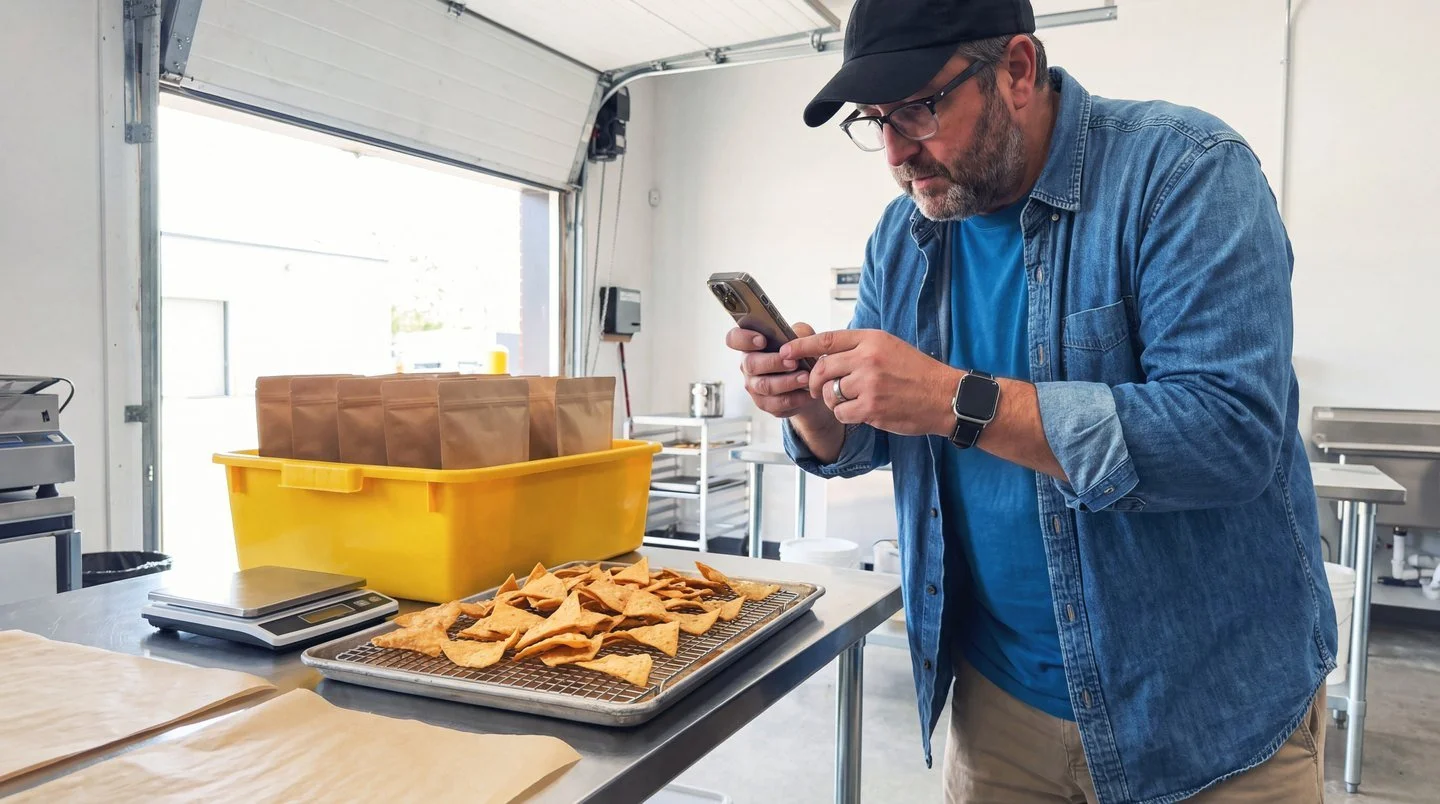
I've watched AI get a food photo wrong in ways a shopper catches in half a second. I'm not writing this as a skeptic. I'm writing it as that guy. I run my own shop on AI every day. The hero images on this blog are rendered from reference photos of me. Every article gets a second pass from a different model before it publishes. The whole operation runs on a handful of Macs in Marfa, Texas, a long way from any agency floor. I've owned gallucci.net since 1996. There are more than 435 posts in the archive.
I made an earlier case for AI strategy built on trust, and that still holds. This piece is the org chart version: who buys what, who rents what, and what never leaves the building.
Where does AI belong in a food or beverage company?
AI belongs in research and in production, and almost never in the face of the brand. This is the sort I run with a brand before anybody opens a new tool.
| Job | Buy, rent or keep | What AI does | What a person owns | |---|---|---|---| | Trend and category research | Buy | Reads menus, reviews, search and social at a scale no intern can | Deciding which trend fits your brand and your plant | | Social listening and comment triage | Buy | Sorts thousands of comments and flags complaints and repeat questions | Every reply that goes out under the brand name | | Content production volume | Rent | Cutdowns, aspect-ratio versions, caption drafts, background plates | The shoot, the product on camera, final approval | | Copy first drafts | Rent | Outlines, variations, subject lines | The voice, the claims, the last edit | | Retail sell-in decks | Rent | Pulls numbers into slides and formats the buyer story | The relationship with the buyer | | Founder voice and face | Keep | Nothing public, maybe a transcript | All of it | | Product claims and labels | Keep | Nothing | Regulatory review and your name on the bag | | Recipes and flavor decisions | Keep | Suggests pairings worth testing | The kitchen, the tasting panel, the final call |
Buy means a subscription you own and run in-house, because the job is steady and the tool is stable. Rent means a person or a partner runs the AI production for you, because the tools turn over every few months and the learning curve is where the money disappears. Keep means AI stays out of it.
If you sell into the clean-label aisle, the keep column gets longer. I walked through that version in read your AI strategy like an ingredient panel.
Why doesn't the enterprise AI playbook fit an independent food brand?
The enterprise playbook assumes you've got people to read what the software hands you. A platform that drafts a category brief every morning is a gift to a twelve-person insights team. To a founder, it's another inbox.
Big food buys AI to move faster through a process that already has a lot of people in it. Independent food has the opposite problem. You've got very little process and even fewer people. The first AI dollar should buy founder hours back. A dashboard nobody opens buys back nothing.
A global brand sells scale, consistency, and nostalgia. An independent brand sells a person, a place, and a recipe. That second difference decides the whole strategy. Your edge is the story big food can't fake. Who made it, where, and why it tastes the way it does. Hand that story to a model and you've given away the one thing a bigger competitor couldn't buy.
What can a small food brand learn from Coca-Cola's AI ads?
Coca-Cola is the most visible AI experiment in the beverage aisle, and it has paid for its lessons in public. In 2023 it launched Y3000, a limited flavor it said was co-created with AI. In November 2024 it ran an AI-generated remake of its 1995 "Holidays Are Coming" trucks spot, and viewers called it creepy and soulless. In 2025 it came back with versions built with AI studios Silverside and Secret Level, swapped the people for animals, and still got mocked over trucks with extra wheels. Production reportedly dropped from about a year to about a month.
Coca-Cola can eat the jokes. Pratik Thakar, their head of generative AI, told The Hollywood Reporter consumer engagement ran "very high," and System1 rated the 2024 film positively. A company that size takes a week of noise and keeps shipping.
McDonald's Netherlands decided it couldn't. In December 2025 it pulled a fully AI-generated Christmas ad after viewers called the visuals creepy and soulless.
Independent brands can't afford either version of that week. AI in the face of the brand is a big-company gamble. Put the same tools behind the camera on the boring work and nobody writes a headline about you.
What goes wrong when food brands use AI?
I catch the same five things in my own renders and drafts before they ever hit a client. That's why each one already has a check in the process.
Invented text. Image models put fake words on packages, menus and shelf tags. If a label shows up in a render, it's wrong, so I ban readable text from the frame entirely.
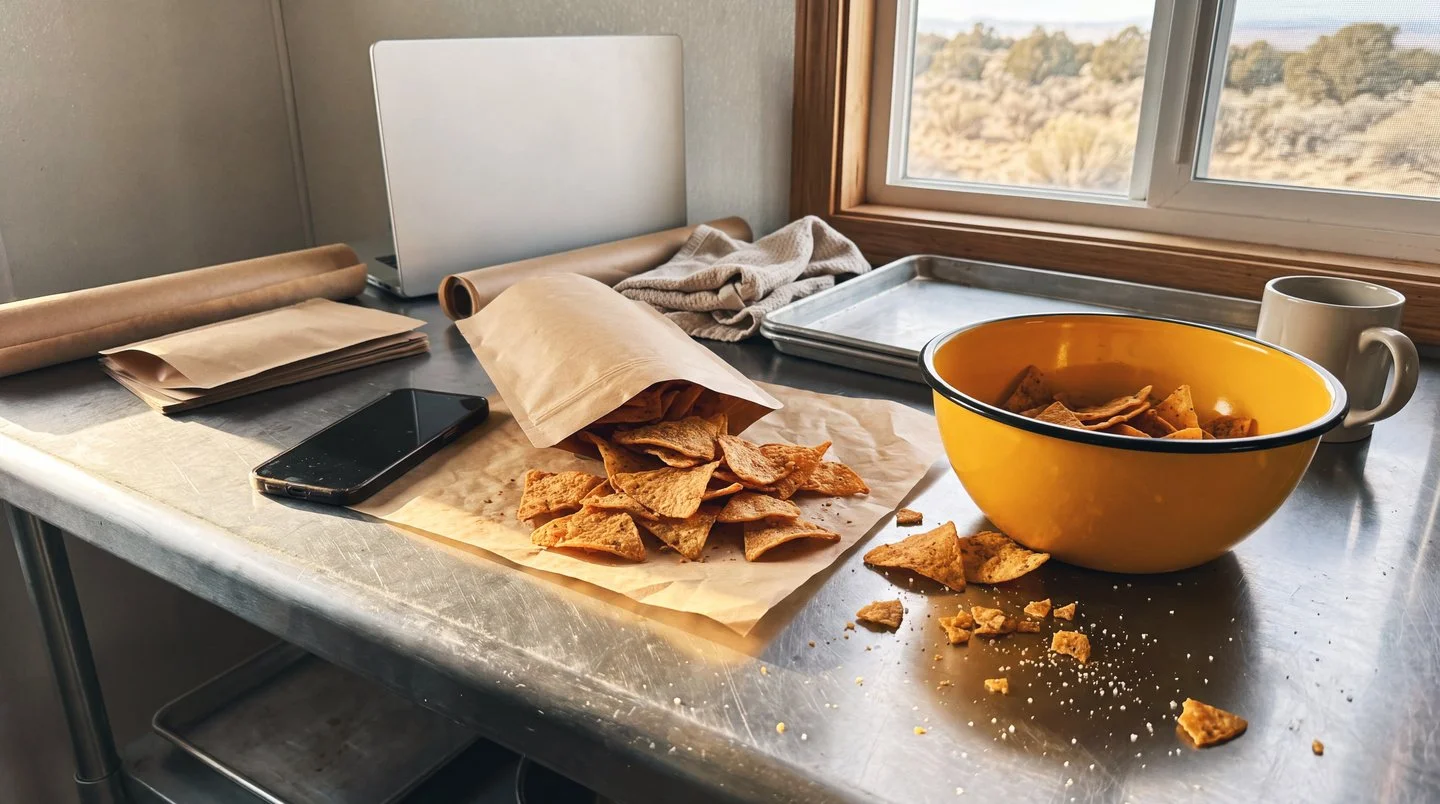
Wrong food. A model will happily give a tortilla chip the texture of a cracker or put ice in a hot coffee. Anybody who cooks sees it instantly.
Wrong hands and faces. Extra fingers are rarer than they were, but a founder who doesn't quite look like the founder is worse than no photo at all.
Confident wrong numbers. A drafting model will invent a statistic, a study or a sales figure and write it with total calm. Every number gets a source or it gets cut.
Machine voice. Certain words and sentence shapes read as AI to anyone who spends time online, and those readers include your buyers. A second pass and a human edit catch most of it.
You don't skip AI for any of that. You put a named person between the model and the public.
How do you build an AI strategy for food and beverage brands in 90 days?
Start with a list of jobs. Here's the 90-day version I'd run with an independent brand.
Week 1, list every recurring marketing job. Write down each task that happens more than once a month, from the broker recap to the Instagram caption. Most brands I sit with find a few dozen.
Week 2, sort each job into buy, rent or keep. Use the table above. Anything touching a claim, a label, a recipe or the founder's face goes in keep, and nobody argues about it.
Weeks 3 to 4, pick one buy and one rent. One research tool, one production job. Measure the hours it saves against the hours it costs to check its work, in writing.
Weeks 5 to 8, write the sign-off rule. Every AI output that goes public carries one person's name in your project tracker. That person read it, checked the numbers and would defend it to a buyer. I laid out the control points for this in run your AI content like a HACCP plan.
Weeks 9 to 12, cut or expand. If a tool didn't save time after checking, cancel it. If it did, add the next job from the rent column.
The 90 days end with a one-page document. That page is the strategy. The software is what you bought to carry it out.
What is the 30% rule for AI, and does it apply to food brands?
The 30% rule is a rule of thumb, not a law or a research finding. People use it two ways: automate about 30 percent of repetitive work first, or let AI handle routine execution while people own the final 30 percent where judgment lives.
For a food brand, that final 30 percent is where all the risk sits. It's the claim on the bag, the photo of the product, the reply to the parent whose kid had a reaction, and the email to the buyer at your biggest account. AI can draft all four. If it gets one wrong, the complaint, the regulator's letter or the lost listing has your name on it, not the software company's.
My read: start with the 30 percent that's boring and low-risk. Resizing, transcribing, first-draft captions, comment sorting. Let AI earn the next slice. The most common mistake I see with AI content is scaling volume before the brand has earned any credibility to scale.
Should you hire an agency, a consultant, or run AI in-house?
Buy jobs stay in-house. One research subscription, one person trained on it. Production doesn't work that way. Image and video tools turn over every few months, and somebody has to keep relearning them. How much production you need and how fast those tools move decides the rest.
A big agency will sell you an AI practice with a deck and a retainer. A consultant or a small AI production shop gives you the person who runs the tools and answers the phone. Most independent food and beverage brands come out ahead on the second option. It costs less and moves faster because there's no committee between the idea and the post. You can see what that looks like in the work I do for food and beverage brands.
It's also worth checking whether anyone can find the help you're hiring. When I typed a buyer's question into an AI assistant, it recommended six agencies and mine wasn't one of them. Ask any partner how they show up when your buyers search.
Before you hire anyone for AI content, ask these:
Show me a post you made with AI that a customer couldn't tell was AI, then show me one that went wrong and what you changed.
Who checks every output before it goes live, and what happens when they miss something?
Which parts of my brand will you never run through AI?
What happens to my workflow when the tool you built it on changes or shuts down?
Who owns the prompts, reference files and renders if we part ways?
If they can't answer the third question fast, keep looking.
FAQ
How is AI being used in the food and beverage industry?
Coca-Cola co-created its Y3000 flavor with AI and has made AI-generated holiday ads two years running. Big companies put AI on trend research, flavor development, demand forecasting, ad production, and customer service. Independent brands get the most from the narrower jobs. Social listening, content resizing and versioning, caption drafts, and retail sell-in decks. A person still approves everything that goes public.
What does Coca-Cola use AI for?
Coca-Cola has used AI in product development and advertising. Its 2023 Y3000 flavor was billed as co-created with AI, and its 2024 and 2025 "Holidays Are Coming" spots were made with generative AI. The 2025 versions, built with studios Silverside and Secret Level, were faster to produce but drew criticism for glitches like trucks with extra wheels.
What is the 30% rule for AI?
Two versions of the same rule of thumb keep turning up. Neither one's a law or a study. Automate about 30 percent of the repetitive work first. You get quick wins and the risk stays low. The other version puts AI on routine execution. People own the final 30 percent that needs judgment. For a food brand, that final 30 percent is claims, labels, product photos, and customer replies.
How much should a small food brand spend on AI?
Buy one listening tool and one production job. Then stop. Measure hours saved against hours spent checking the output. Expand only what pays for itself inside 90 days. The software bill isn't the real cost. It's the time somebody burns learning tools that change every few months. Renting production usually beats building it.
Will AI-generated content hurt my brand's trust?
It can. Coca-Cola and McDonald's Netherlands both drew public criticism for AI holiday ads, and McDonald's pulled its spot. Shoppers react worst when AI replaces people, faces and the food itself. AI used behind the camera for resizing, drafting and research rarely draws attention, because the founder, the product and the voice your customers know stay human.
What should a food or beverage brand do this week?
Pull up the last 30 days of posts, emails and sell-in decks and write every recurring job on one page. Mark each one buy, rent or keep. Then pick the single most boring rent job and hand it to AI with a named person checking the output. That's an AI strategy for food and beverage brands you can start Monday, and it costs an afternoon.
I set this up for a handful of food and beverage brands a quarter. If yours is next, message me on LinkedIn.

adage, emmy, telly & webby award-winning digital marketing consultant for purpose-driven food & beverage brands.