DoorDash's Assistant Builds The Cart Now. Whatever You Left Blank, It Guesses.

The aisle browse was the only free trial your brand ever got. Last week grocery packed into Las Vegas for Groceryshop and walked through how it'll automate that browse out of the store. Nobody said the quiet part. An assistant reads none of the packaging you spent the budget on.
Here's what actually got said. DoorDash co-founder Andy Fang told the room on September 23 that orders placed through Ask DoorDash come back with baskets 50 percent bigger than orders placed without it, checkout five times faster, and 60 percent more unique items. At the June launch that basket figure was 35 percent. It moved fifteen points in a quarter. Albert Heijn's in-app AI chef, Steijn, is at 1.1 million active users who spend 56 percent more than shoppers who ignore it. Kroger's chief digital officer Yael Cosset described a three-stage road from assisted to augmented to autonomous, with the shopping assistant already rolled out across every banner this summer. Giant Eagle put a recipe generator on its main grocery app and talks about agentic AI mostly as a way to move single-channel shoppers into omnichannel, where lifetime value runs about 30 percent higher. Modern Retail and Digiday both wrote the same story out of the same week, which is usually the tell that a thing is real rather than pitched.
Accenture brought the demand side. Consumer Pulse hit 25,000-plus people across 16 countries and found 74 percent would trust a personal AI agent more than their best friend to make a purchase for them. About a third would let the agent make the final call inside boundaries they set on price and preference. Nine percent would hand it the whole errand.
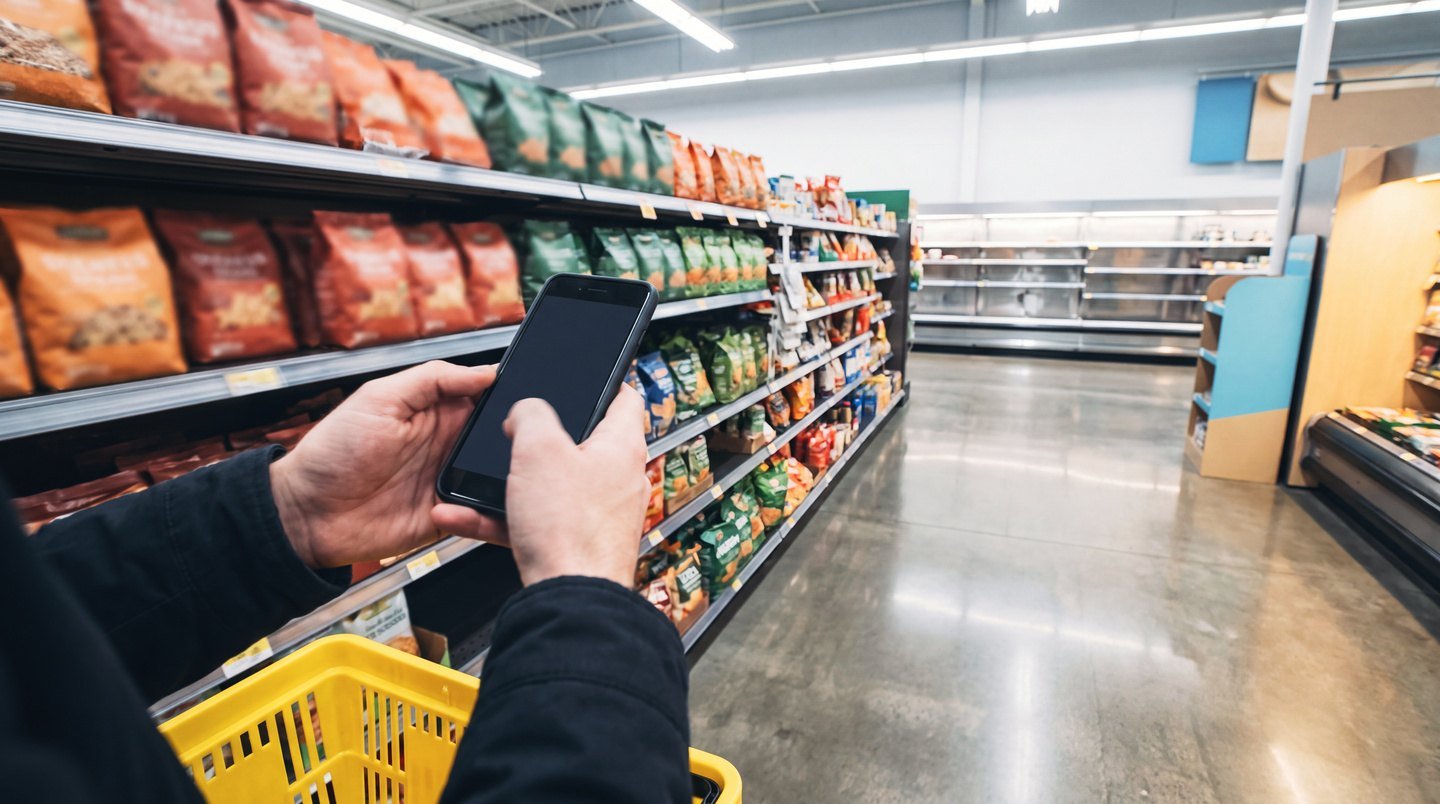
So picture the shopper you have been courting for two years. She types "taco night for four, nothing ultra-processed, under forty dollars." She is not walking the aisle. The aisle is where your label did its work: the eleven-item panel, the name of the ranch, the color that didn't look like everything else on the shelf. The assistant sees none of that. It sees fields. Ingredient declaration, allergens, certifications with the issuing body, serving size, origin, claim plus substantiation. Wherever you left a field empty, it does not leave a hole. It fills the hole with whatever else it can find about you on the internet.
I pointed one at myself this week. I know exactly what that looks like.
On September 30 I ran three buyer questions through an assistant with live web search turned on and wrote down what came back. The third one was the plain one: who is giovanni gallucci and what does he sell, at what price. It answered at length and mostly correctly. Then it quoted a price, and the price it quoted came off an Instagram caption I posted on February 16. A hundred twenty-five dollars a finished image, twenty-image monthly minimum, twenty-five hundred to start. That's seven months old. It is not what I charge. The assistant wasn't wrong to use it, either. It went looking for a number, my site doesn't publish one, and a caption is a number. It also dug a phone number out of a press release from 2023 and handed that over like it was current.
The shops that publish their rates got described by their rates. The assistant handed back monthly dollar ranges for the ones with a pricing page, dropped them under a heading that said strong fit, and sorted them by what they cost. I got a hedge and a verb. He describes running social strategy and content creation. Describes. That word is the machine telling you it could not check.
Nobody sanded me down out of malice. I left the field blank and the field got filled. That is the whole mechanic, and it is about to run on your SKU instead of my rate card.
What the blank fields cost a food brand
This is a records problem wearing a marketing problem's clothes, and the big players already staff for it. Data governance is somebody's full-time title over there, and the title exists because complete product records in every retailer's system are worth paying a salary for. On an independent brand that work belongs to a founder at eleven at night after the pallets go out, which means it is the thing that slides.
Three specifics worth more than a strategy deck.
Retrieval is literal. "Clean label" retrieves nothing, because nobody types it. "No seed oils, no gums, eleven ingredients, milk from one dairy in Erath County" retrieves four separate questions people actually ask. A shopper asking her phone for something with no seed oils is a query with an answer or no answer. Aspirational language has no answer in it.
"Natural flavors" reads as missing data. To a human shopper that phrase is a little mystique, a little proprietary shrug. To a retrieval system it is an unfilled field, and unfilled fields lose to filled ones. If your formulation has a reason for the vagueness, fine, but understand the price has changed. Vagueness used to cost you a skeptical shopper. Now it costs you the recommendation before a shopper is in the room.
The cheapest useful thing you can do this week takes twenty minutes. Pull up Ask DoorDash, your grocer's app, and one assistant, and ask for your category three different ways. Write down what came back. Not whether you were mentioned, that part stings and teaches you little. Write down which attributes it quoted about whoever won, and where it went to get them. That tells you which of your fields are empty, in the order the machine cares about. Almost nobody on your team has done this, and the answer is usually embarrassing in a way that's easy to fix.
The uncomfortable part is that this favors whoever was already telling the truth in a checkable way. A brand whose panel really does run eleven items can publish all eleven. A brand renting the word artisanal cannot publish anything, because there's nothing under it to publish. Transparency stopped being a brand value this month and turned into a retrieval requirement, which is a demotion in poetry and a promotion in consequence.
Independent brands have about two years to become legible to the thing building the cart, and legible is a lower bar than loud ever was. Most of the work is boring, most of it is free, and almost none of it is social media in the sense anyone means when they hire for social media marketing for food brands. It's going through your own published record the way a machine reads it, finding every place you wrote a feeling where a number belonged, and replacing it.
Start with the field you would least like a stranger to guess at. Somebody already is.
I do this for a handful of food and beverage brands a quarter. If yours should be one of them, message me on LinkedIn.
---
Related reading:

adage, emmy, telly & webby award-winning digital marketing consultant for purpose-driven food & beverage brands.