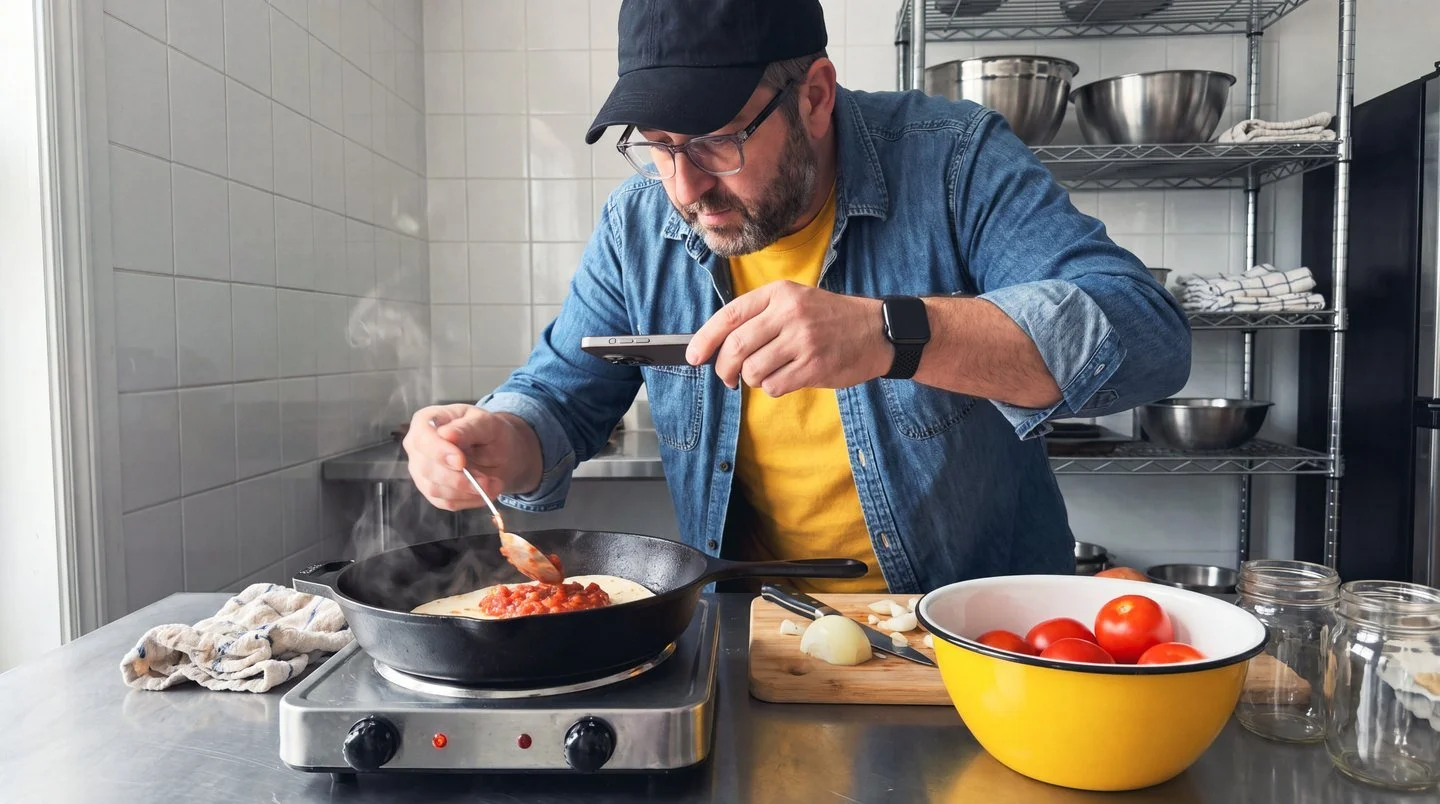
Social media marketing for food brands: Google keeps handing you a restaurant playbook
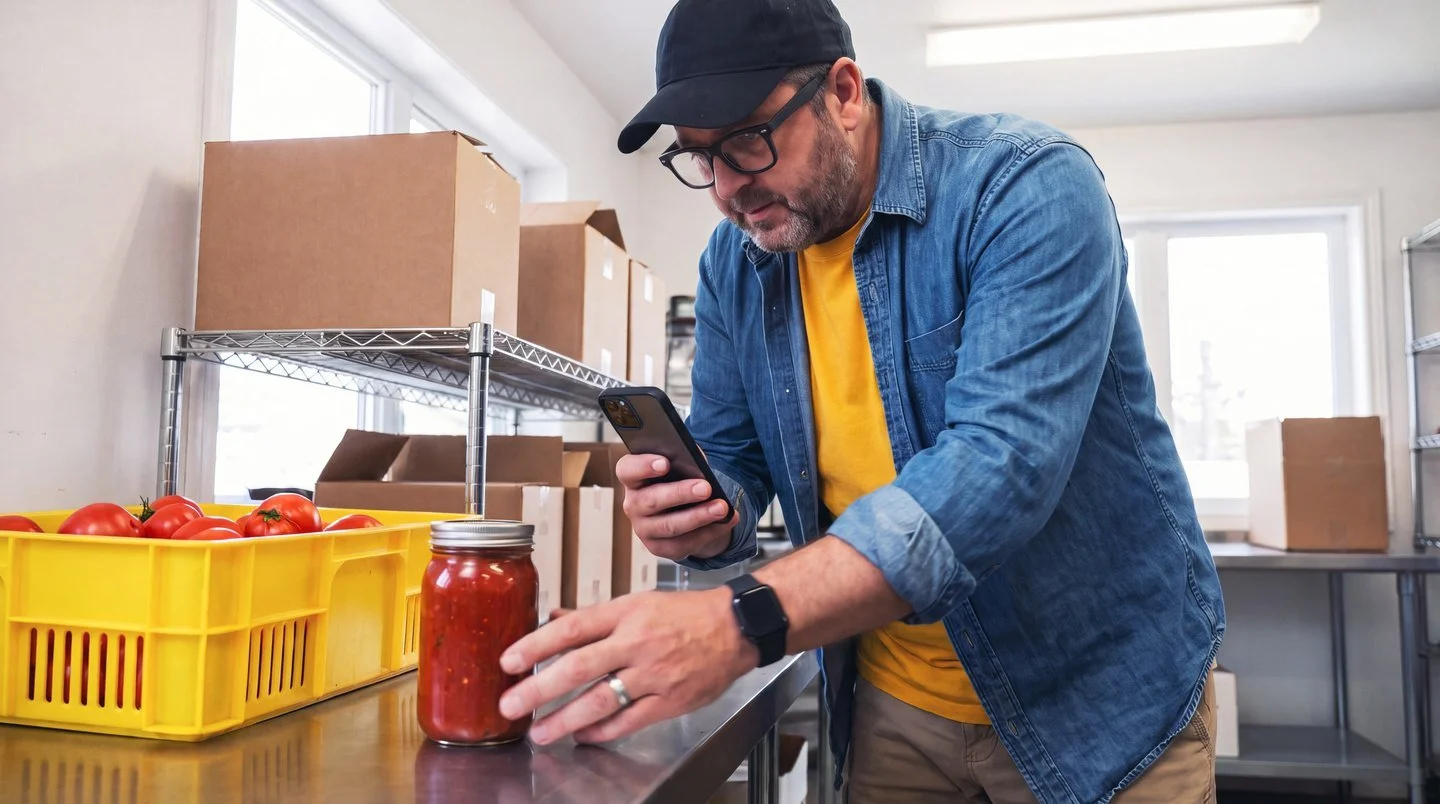
Social media marketing for food brands is shelf work, and Google keeps answering it with restaurant advice. On November 22, 2026, two of the top six results were restaurant guides and five of six related searches said "restaurant." A restaurant sells tonight's table nearby. A packaged brand sells the same product in stores it never sees.
Updated November 23, 2026
I ran the search "social media marketing for food brands" the night before this went up. The #1 result is still a June 2026 fact sheet from Oklahoma State University Extension, and its two cautionary tales are a beer brand and Cracker Barrel, a restaurant chain. Number three is a Deloitte Digital piece on social strategy for restaurants. Number six is a restaurant marketing blog from a restaurant software company. Then the related searches at the bottom of the page: restaurant agency, restaurant strategy PDF, restaurant marketing ideas, restaurant marketing jobs, and how small restaurants use social media.
So a founder with a sauce in 200 grocery stores types a reasonable question and gets handed a playbook built for a taqueria with a patio. Some of it transfers. A lot of it works against you, and the parts that don't transfer are the ones that decide whether a retail buyer reorders.
I've run organic social for food and beverage brands for more than twenty years, from a domain I've owned since 1996 and these days from a desk in Marfa, Texas. The single most common mistake I see on packaged food feeds is a brand posting like a restaurant.
The short version
- A restaurant's audience lives within a short drive and can act tonight. A packaged food brand's audience is spread across every store that carries it and buys days or weeks later.
- Restaurant social sells the room, the daily special and the reservation. Food brand social has to sell one unchanging product, the moment people use it and the store where they find it.
- Restaurants can count covers the same night. A food brand can't see its own register, so it has to pick a proxy and track it on purpose.
- Before you hire help, ask whether the person has ever been measured on retail sell-through or only on foot traffic.
Why does Google mix restaurant advice into food brand searches?
Because restaurants publish far more marketing content than packaged food brands do, and Google ranks what exists. There are many more restaurants than there are emerging grocery brands, and every reservation platform, POS company and restaurant agency writes blog posts to sell to them.
The result is a search page where "food brand" and "restaurant" blur together. The words overlap. The jobs don't. A restaurant manager asking how to fill Tuesday night and a founder asking how to get a second facing at a regional chain are asking two different questions, and only one of them has a few thousand blog posts written for it.
Shopper demand is there, which is why getting this right pays. When FMI and NielsenIQ released their Digital Engagement Transforms Grocery Shopping report in February 2025, 55 percent of respondents said they make direct purchases from social media or livestream platforms for grocery and household items. Shoppers are buying groceries off their feeds. They just aren't buying them the way they book a table.
How is social media marketing for food brands different from restaurant marketing?
Geography, time, and what you're allowed to change. That's the split. A restaurant runs its room, its menu, and its hours. A packaged food brand runs the product and the story. It rents everything else from the retailer.
| | Restaurant | Packaged food brand | |---|---|---| | Where the audience is | Within a short drive of one or a few locations | Spread across every store and online channel that carries the product | | When they act | Tonight or this weekend | Next grocery trip, often a week or more out | | What changes daily | Specials, events, the chef, the crowd | Almost nothing. The product is the same every day | | What the post has to sell | The visit | The use, the moment and the store | | What you can count | Covers, reservations, online orders | Store-level velocity, where-to-buy clicks, retailer data if you can get it | | Who else is watching | Diners and local press | Shoppers, retail buyers, brokers and distributors | | Biggest risk | A bad night going viral | A feed that never tells anyone where to buy |
That middle row is where most food brands get stuck. A restaurant never runs out of things to post because the kitchen changes every day. Your salsa is the same salsa it was in March. Restaurant advice says "post your daily special." You don't have one, so the feed fills up with the same jar from different angles and engagement slides.
Make the subject what people do with the product. That's the fix.
What should a food brand post instead of restaurant-style content?
Post the use, the person and the place to buy. In that order, most weeks. This is the framework I hand to a brand in its first month with me.
- Pick three use occasions that are true for your product. A hot sauce might own eggs on Sunday, a weeknight taco and the tailgate. Done when you can name each one in five words or fewer.
- Film each occasion with a person and actual food, shot on a phone. Hands, a messy counter, the jar half empty. Done when a stranger could tell what the product is for with the sound off.
- Answer the questions shoppers actually ask in your comments and reviews. Heat level, allergens, how long it keeps after opening. Done when every question from the last 60 days has a post or a pinned reply.
- Say where to buy it in a plain sentence at least once a week, by retailer and by region. Done when a follower in any market you're in could find you without leaving the app to search.
- Give the retail buyer something to see. A store shelf shot from a real shopper, a demo table, a reorder. Done when you could send your last ten posts to a buyer without explaining any of them.
Notice what isn't on the list: hours, events, "come see us this weekend." Those are restaurant moves. They make sense when the customer can show up tonight. Your customer shows up whenever they're out of whatever they buy instead of you.
How do you measure social media when you can't see the register?
You pick one proxy you can count every week and you stick with it long enough to see a trend. A restaurant knows by 10 PM whether a post filled seats. A food brand sells through a retailer's register, and that data arrives late, aggregated and sometimes not at all.
Proxies that hold up for packaged food:
- Clicks on a where-to-buy link or store locator, counted weekly
- Comments and DMs that name a store ("found it at my H-E-B")
- Saves on recipe and use-occasion posts, which track intent better than likes
- Store-level velocity in the markets where you push content harder, compared against the markets where you don't
The last one is the closest thing you'll get to proof. If you can see sales by store or by region, run heavier content in two markets for eight weeks and leave two alone. That's a crude test, and it beats every engagement rate report I've ever been handed.
Creator content counts here too. Salsify's 2025 consumer research found 42 percent of food and beverage online shoppers had bought a product because a social media influencer recommended it. If you pay creators, pay them on something you can see. I wrote about deciding what a lead is before you pay a creator on results, and the same rule applies to your own feed.
What does hiring help for food brand social media look like?
You're hiring someone who understands retail, not just content. Plenty of talented people have built their whole portfolio on restaurants, and their instincts are tuned for foot traffic. Those instincts will cost you if your sales happen on a shelf.
Ask these before you sign anyone:
- Have you ever been measured on retail sell-through, and what did you track?
- How would you tell a shopper in Dallas and a shopper in Denver where to buy us?
- What would you show a retail buyer from our feed?
- Who shoots the content, and who owns the footage when we part ways?
- What do the first 90 days look like, week by week?
A good answer to that last question sounds like this: audit and use occasions in the first two weeks, a regular posting rhythm on two or three platforms by week four, a where-to-buy habit in place by week six, and a first read on your chosen proxy by week twelve. If someone promises viral, keep walking.
The choice between in-house, an agency and an independent consultant depends on volume. A brand in a few dozen to a few hundred stores usually gets the most from a senior independent person or a small team where the person you met is the person doing the work. I've laid out what I offer and how I work if you want to compare. And if the Google Maps message button pulled you into restaurant-style DMs, that's one restaurant habit worth borrowing: answer fast.
An earlier article here looked at the same #1 result from a different side and argued that Google's top answer was written for a salsa stand at a farmers market. This one is about the brand that already left the market and keeps getting advice meant for a dining room. If your product feels too plain to post about, start with social media for food brands that think their product is boring.
FAQ
What is the 5-5-5 rule for social media?
There's no single 5-5-5 rule. One common version means five platforms, five daily engagement actions and five metrics. Another splits content into five educational, five engaging and five promotional posts. For a packaged food brand, five platforms is too many. Two or three platforms done well, with a clear where-to-buy line every week, will outsell five half-maintained accounts every time.
How do you promote food on social media?
Show a person using the food at an ordinary meal, then tell people where to buy it. For a packaged brand that means filming use occasions like a weeknight dinner or a Sunday breakfast, answering shopper questions about heat, allergens and storage, and naming the retailers that carry you. Restaurant tactics like daily specials and event posts rarely fit a product that's the same every day.
What is the 3-3-3 rule in marketing?
Marketers use the 3-3-3 rule in a few different ways. One version splits content into thirds: educational, promotional and entertaining. Another means three core messages, three audience segments and three channels. For a food brand the second version is more useful, because it forces you to say the same few things on a few platforms often enough that a shopper remembers them in the aisle.
What is the 70/20/10 rule in social media?
The 70/20/10 rule is a posting mix. About 70 percent of posts give the audience something useful, 20 percent feature other people or businesses, and 10 percent promote directly. A packaged food brand can use the 20 percent to feature the stores that carry it, a farmer or a creator, which does double duty by telling shoppers exactly where the product sits on a shelf.
Should a packaged food brand hire a restaurant social media agency?
Only if they've also worked on retail brands and can show it. Restaurant agencies are built to drive visits and reservations, and they measure success the same night. A packaged food brand needs someone who thinks in use occasions, where-to-buy messaging and store-level velocity. Ask for one example where their content was tied to retail sales, and listen for specifics instead of engagement rates.
What to do with your feed this week
Scroll your last 20 posts. Count how many actually tell a shopper what the product is for and where to grab it. Under five and you've been running a restaurant feed for a product that lives on a shelf.
Pick your three use occasions, film one this week on a phone with a real person and real food, and put a plain where-to-buy line under it naming your retailers. Then choose the one number you'll count every Monday for the next eight weeks, and write it down before you post.
---
The Daily Food & Beverage Brief: $27 a month
One email every morning, seven days a week, covering the whole food and beverage industry: price increases, launches, retail moves and policy changes, what each one means, and ten moves you can make that day, split by role. The Bottom Line reads in about a minute. It's self-serve, you can cancel anytime, and your first brief arrives tomorrow morning. That's $324 a year, less than a standard BevNET membership.
See the Daily Food & Beverage Brief · Read a free sample (PDF)

adage, emmy, telly & webby award-winning digital marketing consultant for purpose-driven food & beverage brands.