Social media marketing for food brands: Google's top answer was written for a salsa stand

Social media marketing for food brands is the work of getting a stranger to recognize your product, trust the people who make it and pick it up on a shelf they're already walking past. Once you're in stores, every post has to do what a farmers market table does in person, without you standing behind it.
I searched "social media marketing for food brands" on October 23, 2026. The #1 organic result on Google is a fact sheet from Oklahoma State University Extension, FAPC-251, called "Why Social Media Marketing Matters: Food Businesses." It was published in June 2026 and runs about 1,250 words. Its success story is a small salsa company that sells to farmers market shoppers and young families and posts three times a week on Facebook and Instagram.
That's good advice for the salsa company. It's a starter kit, and it was written as one. The person typing this search is more often running a brand that already left the market table, with product in a few dozen or a few hundred stores and a retail buyer who wants to see it move. The fact sheet stops right where that brand's problem starts.
Key takeaways
- The #1 Google result for social media marketing for food brands is a university extension fact sheet for small producers getting started, and its model brand is a salsa stand.
- A farmers market table does five jobs at once: a face, a taste, an answer, a place to find you next week and a reason to come back. In retail, the feed has to do all five without you there.
- Posting more doesn't fix weak posts. The fact sheet's own failed example posted more and sales stayed flat.
- Judge the work on strangers reached near your stores, saves and sends, how fast comments get answered and units by store. Follower count comes last.
What does Google's top answer get right, and where does it stop?
It gets the foundation right: know your brand, your audience and your goal before you post, and stay consistent. It stops before the questions a brand in retail has, which are what to post, how to tell if it moved product and who should do the work.
The fact sheet leans on Mintel's 2025 research on social media and food. Nearly 90 percent of Americans report daily activity on social media, and 56 percent say social platforms help them discover new foods and recipes. Those numbers are the reason the search exists. They don't tell a founder with three SKUs and a broker what to film on Tuesday.
Its weak example is the useful part. A snack company opens an account on every platform, posts product photos one week and memes the next, leaves comments unanswered and boosts posts without tracking anything. It posts a lot more, and sales stay relatively flat. I've sat across the table from that brand more than once. The fix the fact sheet offers is consistency, which is right and also the part every food brand already knows it should be doing.
What it leaves out: there's no measurement beyond "engagement," nothing on what a post looks like when nobody from the company is in the room, nothing on retail, and nothing on whether to do this yourself or hire it out. Those are the questions that keep a founder up at night, so that's where this goes.
What does social media marketing for food brands have to do once you're in stores?
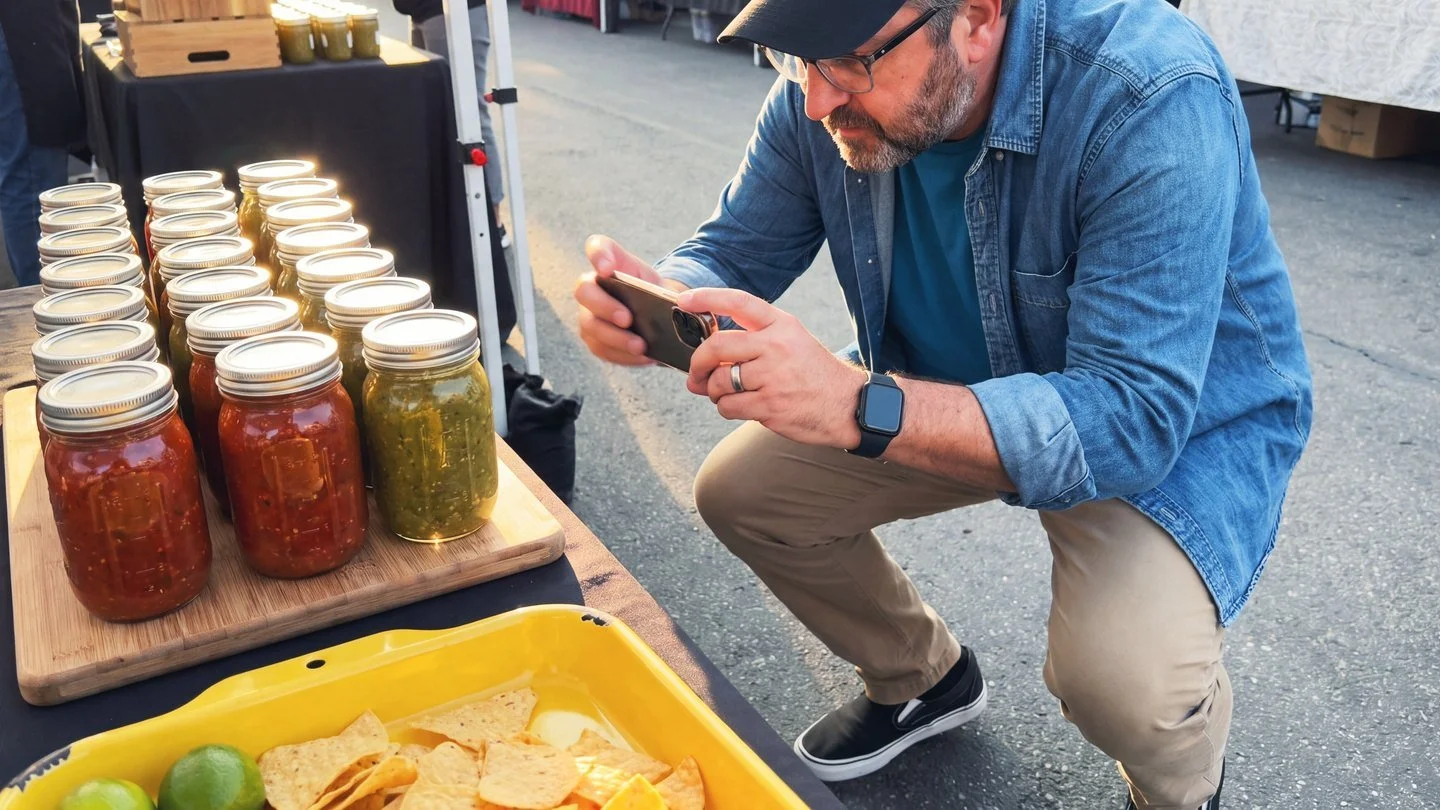
The feed has to replace the market table. At a farmers market the founder hands you a chip, answers the question about the chiles, and tells you which Saturday they're back. Nobody does that in a grocery store, so the feed has to do it before the shopper hits the aisle.
I call it the market table test. Pull your last 12 posts and run them through it.
| What the market table does | What the feed has to do instead | What to check on your last 12 posts | |---|---|---| | A face behind the product | Show the person who makes it, by name, doing the work | How many posts show a real person from the company | | A taste | Show someone eating it, with a real reaction | How many show the food being eaten, not just plated | | An answer to a question | Answer the questions shoppers ask in the comments and DMs | How many posts answer a question a shopper asked | | A place to find you next week | Say which stores and which aisle | How many posts name a store, a city or a shelf | | A reason to come back | Give a recipe, a use or a pairing they'll try at home | How many posts give the shopper something to do with it |
Most brands I look at score well on the first row and badly on the fourth. They'll show the founder in the kitchen and never once say the product is at H-E-B in Austin on the bottom shelf by the salsa verde. That's the farmers market habit carried into retail. At the market, the shopper is already standing in front of you, so you never had to say where you were.
Chick-fil-A is a big company, but the way it built Instagram fits a small brand fine. Digiday reported that its food photos are shot on an iPhone and never retouched beyond a filter, that every photo tries to include a human element like a hand reaching for a milkshake, and that the brand responds to about 35,000 social media mentions a month. A face, a taste and an answer, at scale. I wrote up a scorecard for grading your own feed on those same three things if you want the longer version.
How often should a food brand post, and on which platforms?
Post as often as you can keep every post passing the market table test, on the two or three platforms where your shoppers already are. For most small food brands that means three to five posts a week on Instagram and TikTok, plus Facebook if your shoppers skew older.
The fact sheet's salsa company posts three times a week. That's a fine number. The mistake is treating the number as the strategy. When I graded my own 435 posts against Google's forum box, volume was the least interesting variable in the whole spreadsheet.
Your stores already told you where to post. Conference speakers didn't. A brand in rural Texas co-ops and one in Brooklyn bodegas shouldn't run the same calendar. One platform done well beats four done the way the fact sheet's snack company did them.
How do you know if social media marketing for a food brand is working?
You know it's working when people who don't follow you yet are seeing it near your stores, saving and sending it, and the stores where it's seen start moving more units. Likes and follower growth are the weakest signals of the bunch.
Here's the order I check, every time:
- Non-follower reach. The share of each post's views from people who don't follow you yet. That's the closest thing social has to a new shopper.
- Saves and sends. A save means "I'll try this later." A send means somebody told a friend. Both beat a like.
- Comment answer time. Every product question answered inside a day is a sale the shelf didn't have to make on its own.
- Location overlap. Your audience's top cities next to your store list. If they don't overlap, your content is selling for a retailer that doesn't carry you.
- Units by store. Ask your broker or retailer for weekly units by store and line them up with what you posted.
When I ran the US social strategy for Topo Chico, the budget was thin and the signal I trusted most was the shelf. The Topo Chico story is mostly about bartenders and people who felt like they found the bottle on their own, and about 12-packs going for $9.99 at places like Honey Bee Market in Detroit. The follower count was the last number I looked at.
Shoppers are also more confused in the aisle than most brands assume. In a Dig Insights study of 500 Americans, roughly half said the functional beverage options leave them overwhelmed, and a good feed can clear that up before the label ever gets a chance.
What does hiring help for food brand social media look like?
Hiring help means paying someone to plan, make and run your social content and report on whether it moved product. Your choices are someone in-house, an agency or an independent strategist, and each fits a different size and stage of brand.
In-house works when there's enough content to fill a full-time job and someone senior who can coach the hire. An agency fits when you need paid media, retail media and creative all at once and have the budget for account management on top. An independent strategist fits a brand that needs a senior person setting the strategy and running production without the overhead. That's the organic social strategy and content production I do for food and beverage brands.
I'm not going to quote prices here, because the honest answer depends on how many SKUs, platforms and posts a month you need. Get scoped quotes and compare the scope line by line. A realistic first 90 days goes like this: month one sets the baseline and runs the market table test, month two tests formats against it, and month three cuts whatever didn't move saves, sends or stores.
Ask anyone you're considering three questions. Which food brand in retail have you grown, and what happened on the shelf? What will you report to me after the first 30 days? What would you stop doing on my feed this week? If the answers start with follower growth, keep looking. I've made the longer case for why food and beverage social media marketing should be graded on what leaves the shelf, and why the big-brand scorecard in Google's top answer for CPG social media misleads smaller brands.
I've held gallucci.net since 1996. The fact sheets still push the same three lines: know your audience, be consistent, be authentic. All true. None of it tells you what to drop in the feed on Tuesday, and that's the job.
FAQ
What is the 70/20/10 rule in social media?
The 70/20/10 rule is a posting mix. As LYFE Marketing describes it, 70 percent of your posts should be useful content that builds the brand, 20 percent should feature other people or businesses, and 10 percent should be promotions or announcements. For a food brand, the 20 percent is a good place for the farmer, the co-packer or a store that carries you, which also tells shoppers where to buy.
What is the 3-3-3 rule for social media?
Marketers use the 3-3-3 rule to mean different things. One common version splits content into thirds: educational, promotional and entertaining. Another means three key messages, three audience segments and three channels. For a small food brand the second version is more useful, because it forces you to pick a few platforms and say the same few things often enough that a shopper remembers them in the aisle.
How does Chick-fil-A use social media?
Chick-fil-A built its Instagram around food photos shot on an iPhone and never retouched beyond a filter, according to Digiday, with a human element like a hand reaching for the food in each shot. Digiday also reported the brand responds to about 35,000 social media mentions a month. The lesson for a small food brand is that a phone, a real meal and fast replies cost very little.
How often should a food brand post on social media?
Most small food brands do well with three to five posts a week on two or three platforms, as long as each post passes a simple test: it shows a person, shows the food being eaten, answers a real question, says where to buy it or gives the shopper something to do with it. Posting more than you can do well tends to flatten results.
Should a food brand hire an agency, a freelancer or someone in-house?
It depends on stage and volume. A brand in a few dozen to a few hundred stores usually gets the most from an independent strategist or a small specialist team, because the senior person does the work. In-house makes sense once there's enough content to fill a full-time job. A full-service agency fits brands buying paid media, retail media and creative at the same time.
What to do next
Pull your last 12 posts tonight and run them through the market table test. Count how many name a store, a city or a shelf. If the answer is zero, start there next week: one post that shows the product in the store where a shopper can buy it, with a person from your company in the frame.
I run the market table test first in every 90-day sprint. Message me on LinkedIn if you want it on your brand.

adage, emmy, telly & webby award-winning digital marketing consultant for purpose-driven food & beverage brands.